The BioChar Workshop at Pony Farm

Last updated June 23, 2009

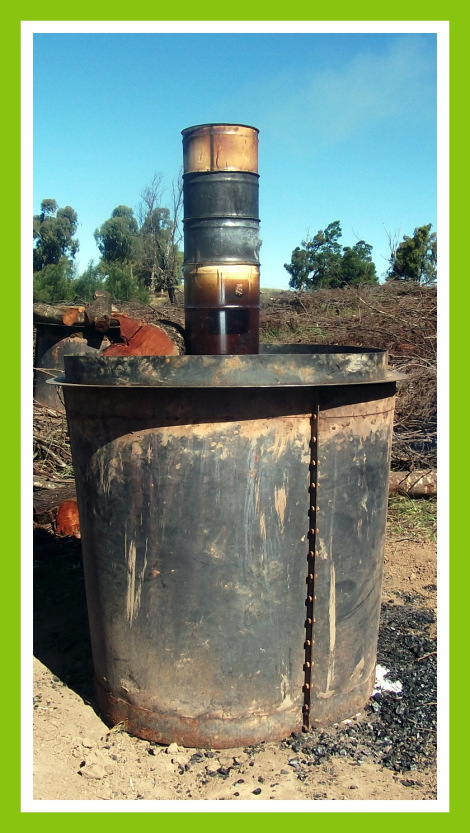
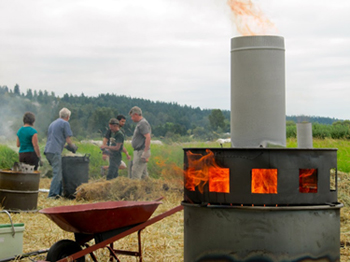
Peter Hirst, Pony Farm in Temple, New Hampshire, on May 9, 2009.

Follow the link for some great video from the recent Biochar Roundtable at the Lodge at Pony Farm in Temple, New Hampshire, on May 9, 2009.

Pony Farm Biochar Workshop

http://thinkingglobalactinglocal.com/biochar-workshop-may-9-2009.html

PyroGen Power Generation

Last updated May 31, 2009

PyroGen Power Generation
R&A Energy Solutions, LLC, May 31, 2009
Pyrogen ProcessPyrogen Process
PyroGen appears to be a company in North Ridgeville, OH that combines a prototype skid mounted pyrolytic sludge reduction process with a genset, both from Indiana.
Skid Mounted PyrolyzerSkid Mounted Pyrolyzer

"R&A Energy Solutions provides integrated, modular pyrolysis and combined heat and power generation equipment for the dairy, cattle feedlot, recycling, waste hauling, municipal utility and auto shredding industries.
Systems are available in 250 pound, 500 pound, 1,000 pound, 2,000 pound and 4,000 pound per hour sizes, producing from 20 Kilowatts to 2 Megawatts and more of power capacity, plus Pyro-Oil and Pyro-Char or Bio-Char."

" PyroGen™ System Throughput Capacity and Power Output:

A standard full scale PyroGen installation is designed to process waste feedstocks in volumes up to 4,000 pounds (two tons) per hour and will normally support three (3) to six (6) I Power Energy Systems 365kw engines/generator sets producing up to 2.2 Mw."

The system is shown schematically along with a list of potential projects in a slide presentation at:
http://randaenergysolutions.com/Waste_to_Energy_Presentation_-_March_23_...

Links:
I Power Energy Systems:
http://www.ipoweres.com/
http://www.ipoweres.com/products.html
http://www.insideindianabusiness.com/newsitem.asp?id=27127#middle

US Thermal Technologies:
http://www.uscentrifuge.com/pyrolytic-sludge.htm
US Thermal Technologies is an affiliate of US Centrifuge
http://www.uscentrifuge.com/

The contact is at R&A Energy Solutions Inc.
http://randaenergysolutions.com/
Email: joel.keller@randaenergysolutions.com

The link to their biochar document:
http://randaenergysolutions.com/R40186_20090203.pdf

BIOCHAR URINALS

Last updated April 30, 2009

1. GEO BIOCHAR URINAL - PVC and 2. GEO BIOCHAR URINAL - CLAY

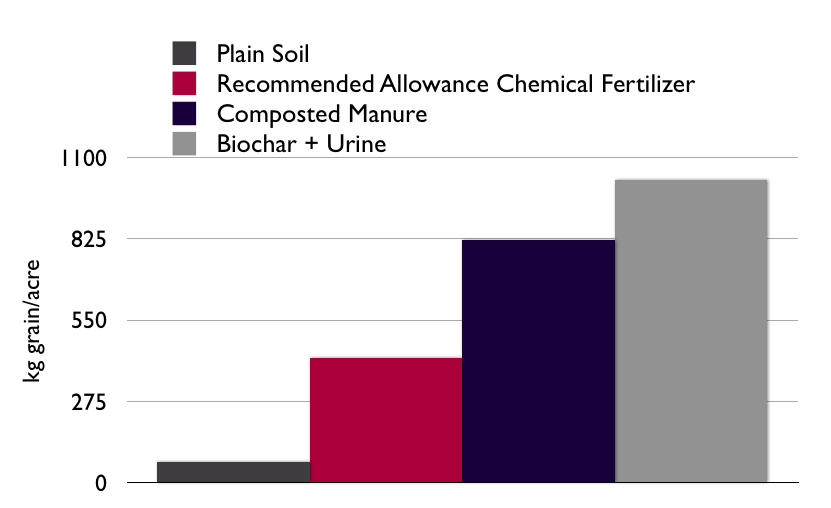
Biochar / charcoal can be used for tapping the Nitrogen and other useful elements. Simple urinals are designed http://e-biocharurinals.blogspot.com/ for tapping the nitrogen and other useful elements for using as a soil amending material for improving the quality of the soils, increasing crop production, addressing the global warming by reducing the NOx emissions, avoiding artificial fertilizers, keeping the toilets clean and odor free, etc.

Two sets of prototype Urinals - PVC urinal and Clay pot urinal are designed and being used by GEO.

The production of fertilizers require lots of energy, in many countries Natural gas is used for producing urea in large quantities. This demand is ever growing and we dont have enough energy to meet the demands. The complex fertilizers are also contributing to alkalinity of the soils.

From the below information we can see that there is a great potential to tap nitrogen from Urine, as biochar has an affinity to tap nitrogen, using charcoal for tapping the Nitrogen and other elements is a great opportunity to find solutions for many problems. Urine is a great source of Nitrogen, Phosphorous and Potassium

For more details please see this blog: http://e-biocharurinals.blogspot.com/

Also see the following links: http://e-opentoilets.blogspot.com/ 

http://e-terrapretarooftopexp.blogspot.com/

Covering the earth with charcoal?

Last updated March 31, 2009

There was a big debate about biochar in last week’s Guardian, between George Monbiot, who thinks it’s being sold as a “miracle mass fuel cure“, and defenders of biochar, including James Lovelock, who agrees that “it would be wrong to plant anything specifically to make charcoal” but that biochar has net benefits if it’s made from agricultural wastes.

Monbiot says what’s being proposed amounts to “turning the planet’s surface into charcoal”. But is it really? I calculated just how much biochar would really be needed to store all the excess carbon dioxide in the atmosphere…

  • The total weight of the atmosphere over each square metre of the Earth’s surface is 10 tonnes. (A handy figure to remember, that.)
  • Carbon dioxide is now present in the atmosphere at 385 parts per million by volume (ppmv), equivalent to 582 parts per million by mass (ppmm).
  • This is 35% higher than pre-industrial levels (284 ppmv = 429 ppmm).
  • So the excess CO2 which needs to be removed is 153 ppmm.
  • Conveniently, 1 tonne = 1 million grams. So one part per million of 10 tonnes is 10 grams. The 153 ppmm CO2 we need to remove comes out at 1530 grams per square metre of the Earth’s surface.
  • By mass, CO2 is 30% carbon and 70% oxygen. So if all that excess carbon dioxide were fixed as charcoal (which is more-or-less pure carbon), it would come to 459 grams per square metre of the earth’s surface.
  • The density of charcoal is 208 kg/m3. So this hypothetical global layer of charcoal would be just 0.459 / 208 = 0.002m, or 2 mm thick.

Not a great deal, if you think about it. But in reality we aren’t talking about the whole earth’s surface, but only about the arable land, because that’s (a) where most of the crop wastes are, (b) where the people are to do the charring, (c) where people are interested in improving the soil, and (d) they are totally man-made ecosystems anyway, so if we need to modify land on a planetary scale, that’s the place to start.

The Earth’s surface area is 51 gigahectares (nice unit!) of which 1.36 gHa are arable (by George M’s figure) - that’s 2.7% of the total. So:

If all the “excess” carbon dioxide in the atmosphere were converted into carbon and spread across all the earth’s arable lands, there would be 17kg of charcoal per square metre, in a layer 8cm thick.

That’s not an unfeasible notion. The Gardening with Biochar FAQ mentions biochar application rates of around 5kg/m2. On the other hand, photos of Terra Preta soils show black layers that are many centimetres thick, so they must contain far more than 17 kg/m2 of carbon.

Original blog post

Energy Cost of Charcoal

Last updated March 26, 2009

Energy Cost of Charcoal
Bryce Nordgren, (Rev) March 26, 2009

Because I really had no idea about how much energy it takes to make
charcoal, I made a table from the specs of the Chinese equipment posted by
gordon eliot. Then I calculated the "Energy Cost" of each component in
(MJ/kg). Finally I aggregated the energy costs from the "suggested
charcoal plants" to get an idea of the energy cost of the entire system.
Note that all of their plants use the new high efficiency coal bar
machine. This should represent a best case scenario: maximum rated
charcoal production at rated power. If you make less charcoal and consume
the same power, the energy cost goes up.

Consider this a first step in understanding the energy efficiency of the
entire process. To complete the analysis, we would have to know the energy
content (MJ/kg) of the produced charcoal. The big question is: can you
power a 30kW generator with the syngas in order to take the small charcoal
plant off the grid?

I hope this comes thru. I'm pasting the tables as html into the mail
message. I'm also attaching the spreadsheet from whence these tables came
in OpenDocument format. I exported the OpenDocument spreadsheet into excel
(attached). This retains the equations so people can plug in their own numbers?
The "source" of the numbers is the Gongyi Sanjin Charcoal Machines Factory:
http://tech.groups.yahoo.com/group/biochar/message/5534.

Charcoal Plant Proposals
# Description Components (MJ/kg) Total
Crusher Drier Coal-bar
1 25-30MT per month 0.00 0.05 0.17 0.22
2 80-100MT per month 0.09 0.03 0.17 0.29
3 180-200MT per month 0.14 0.02 0.17 0.32

Note that the bigger crushers have a higher energy cost than the small
crushers. I would have expected the reverse. Also, the high-efficiency
energy saving coal bar machine is less efficient than the multi-function
coal bar machine. The net result is that larger charcoal plants appear to
be less efficient (have a higher energy cost) than smaller plants. As the
table shows, inefficiencies in the crusher overpower the efficiency gains
by the drier. The most efficient small scale plant would include the 11kW
coal bar machine instead of the "high efficiency" 15kW one.

This message is intended to give ballpark figures for the energy cost of
producing biochar using a sample of COTS equipment specifications. It
does not represent an endorsement or criticism of the vendor by any
agency, department, or program of the United States Government.

Bryce Nordgren
bnordgren@fs.fed.us

Biochar use - Munda Tribals, India

Last updated March 15, 2009

Munda tribals living in parts of Orissa, Jharkhand and West Bengal states, in India, use biochar for increasing the crop production. They mix charcoal with farm yard manure (pellets of small ruminants / cattle dung) and add to the red lateritic soils which are other wise less fertile. They cultivate vegetables and green salad in the well fenced plots of about 1 acre in size. The biochar is mostly a byproduct from the biomass cook stoves in use (most often three stone stoves / simple clay earth stoves). They have access to wood from the jungles, which is used as fuel.

For more details see the photos
http://picasaweb.google.com/saibhaskar.geo/TP_Sign_Keonjhor_Orissa#
http://picasaweb.google.com/saibhaskar.geo/TP_Sign_Keonjhor_Orissa?feat=...

and a small video film.
http://video.google.com/videoplay?docid=-5144451319506748375
Latitude: 21.9722721074 Longitude : 85.2820737194


For more pictures see http://e-terrapreta.blogspot.com/

Biochar Makes Organic Farming Practical

Last updated March 10, 2009

Biochar Makes Organic Farming Practical
AJ Morris,Organic Gardening December 18, 2008

"Almost every farmer is aware of organic techniques for fertilizing crops, yet the majority still use chemical fertilizers — why is that? Dig a little deeper (excusing the pun) and you will find that it is not uncommon for a family farm to have an organic garden for their own vegetables, but still use chemical fertilizers on their commercial crops. They know organic is better, so why use chemicals?

The answer lies in simple economics. Preparing compost is labor intensive, and labor is expensive. Also, specialized farmers rarely produce the right mix of high-carbon and high-nitrogen materials to produce compost in sufficient quantities to keep large acreage productive. Then there are the issues with pest control, which is easier with chemicals. That is one area I can’t claim biochar will help much — but for the soil fertilization it solves several problems at once.

The rising cost of petroleum-derived fertilizers has some traditional farmers taking a second look at organic methods already — add biochar to the mix and the equation turns around completely."

See full story at: Organic Gardening - Biochar

Sorption Hysteresis of Benzene in Charcoal Particles

Last updated March 07, 2009

Sorption Hysteresis of Benzene in Charcoal Particles
Washington J. Braida,Joseph J. Pignatello, Yuefeng Lu,Peter I. Ravikovitch,Alexander V. Neimark,and Baoshan Xing, Environ. Sci. Technol., 2003

Charcoal is found in water, soil, and sediment where it may act as a sorbent of organic pollutants. The sorption of organic compounds to natural solids often shows hysteresis. The purpose of this study was to determine the source of pronounced hysteresis that we found in the sorption of a hydrophobic compound (benzene) in water to a maple-wood charcoal prepared by oxygen-limited pyrolysis at 673 K. Gas adsorption (N2, Ar, CO2), 13C NMR, and FTIR show the charcoal to be a microporous solid composed primarily of elemental (aromatic) C and secondarily of carboxyl and phenolic C. Nonlocal density functional theory (N2, Ar) and Monte Carlo (CO2) calculations reveal a porosity of 0.15 cm3/g, specific surface area of 400 m2/g, and appreciable porosity in ultramicropores <10 Å. Benzene sorption−desorption conditions were chosen to eliminate artificial causes of hysteresis (rate-limiting diffusion, degradation, colloids effect). Charcoal sorbed up to its own weight of benzene at 69% of benzene water solubility. Sorption was highly irreversible over most of the range tested (10-4−103 μg/mL). A dimensionless irreversibility index (Ii) (0 ≤ Ii ≤ 1) based on local slopes of adsorption and desorption branches was evaluated at numerous places along the isotherm. Ii decreases as C increases, from 0.9−1 at low concentration to 0 (fully reversible) at the highest concentrations. Using sedimentation and volumetric displacement measurements, benzene is observed to cause pronounced swelling (up to >2-fold) of the charcoal particles. It is proposed that hysteresis is due to pore deformation by the solute, which results in the pathway of sorption being different than the pathway of desorption and which leads to entrapment of some adsorbate as the polyaromatic scaffold collapses during desorption. It is suggested that intra-charcoal mass transport may be influenced by structural rearrangement of the solid, in addition to molecular diffusion.

Characteristics and sorption properties of charcoal in soil with a specific study of the charcoal in an arid region soil of Western Australia

Last updated March 07, 2009

Characteristics and sorption properties of charcoal in soil with a specific study of the charcoal in an arid region soil of Western Australia
Claire Louise McMahon, University of Western Australia,Thesis, 2006

Fire creates charcoal from the partial burning of biomass which results in a biologically inert form of carbonaceous (non-living) organic matter that, once integrated into soil and sediments, can persist for long periods of time. Charcoal has a large surface area with a high sorptive capacity for organic and inorganic substances. As a repository for metal and non-metal elements charcoal has been given little, if any, attention in the fields of geochemistry, agriculture and environmental monitoring . . . Despite the differences in charcoal surface area, soil charcoal achieved nearly 100% sorption of 0.5 and 5 μg/g Au from 0.03 M NaCl and 0.01M Ca(NO3)2 solution, almost independent of solution pH. At low pH, charcoal sorbed between 10 and 60% of Cu with initial additions of 2 and 20 μg Cu/g. Similarly, between 15 and 40% of Zn was sorbed by charcoal with initial additions of 5 and 40 μg Zn/g. The role of surface area in sorption of elements by charcoal is clearly only one factor that is important. Charcoal aromatic and aliphatic chemical functional groups, which can be distinguished from other forms of organic matter through spectroscopic determination, are also important in charcoal’s capacity to sorb elements. Accumulation of Be, B, Na, Mg, Al, Si, K, Ca, Ti, Mn, Co, Ni, Cu, Se, Mo, Ba, Au and Pb (out of a range of 29 elements) in soil charcoal, above the concentrations in the matrix soil and plant reference charcoal, was confirmed by ICP-MS analysis. Concentrations of V, Mn, Co, Ni, Cu, Mo, Ba, Au, Pb and Bi were higher in soil charcoal than in values quoted for gossans and pisolites in the field area region (Smith and Perdrix, 1983). Higher values of Au in soil charcoal were associated with considerable amounts of included clay minerals and higher values of other elements including Mo, Mn and Fe.

Optimization of Stormwater Filtration at the Urban/Watershed Interface

Last updated March 07, 2009

Optimization of Stormwater Filtration at the Urban/Watershed Interface
Hipp, J. A.; Ogunseitan, O. A.; Lejano, R.; Smith, C. S.
Urban Water Research Center, UC Irvine, CA www.uwrc.uci.edu

Tests of charcoal in polybags for storm water filtration.

Abstract:
Environmental pollution from cities is a major ecological problem attributed to contaminated runoff from nonpoint sources. The U.S. Environmental Protection Agency's guidance on implementation of total maximum daily loads (TMDL) does not adequately cover methods to improve waters impaired by nonpoint sources. To comply with TMDLs, cities may install filters in curb inlets, or use other Best Management Practices (BMPs). We tested 10 different filters and found their effectiveness in retaining pollutants ranged from 0 to >90%, depending on combinations of pollutant types (metals, pathogens, and total suspended sediments (TSS)) and filter materials. Hence, the decision to deploy filters into curb inlets must consider land use patterns associated with specific categories of pollutants generated within cities. We developed a geographic information system (GIS)-enabled model for estimating and mitigating emissions of pollutants from urban regions into watersheds. The model uses land use categories and pollutant loadings to optimize strategic placement of filters to accommodate TMDLs. For example, in a city where the landuse pattern generates 4 × 10⁶ kg of TSS, 55 kg of Cd, and 2 × 10³ kg of Zn per year into 498 curb inlets that discharge into a sensitive watershed, the optimized placement of 137, 92, and 148 filters can achieve TMDL endpoints for each pollutant, respectively. We show further that 158 strategically placed filters effectively meet the requirements simultaneously for all three pollutants, a result at least 5 times more effective than random placement of filters.

Published in:
Optimization of Stormwater Filtration at the Urban/Watershed Interface
J. Aaron Hipp,, Oladele Ogunseitan, Raul Lejano, and, C. Scott Smith
Environmental Science & Technology 2006 40 (15), 4794-4801

Syndicate content