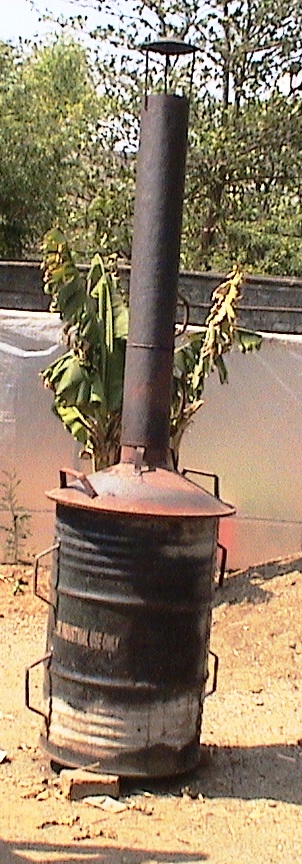
Top-lit updraft kiln (TLUD)

Don't Barbecue - Char-BQ!

Last updated August 10, 2010
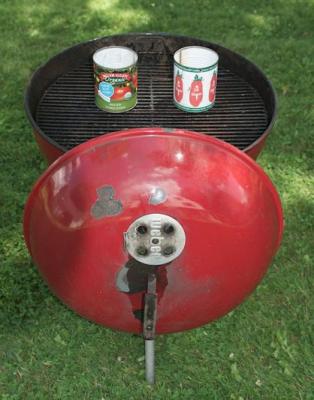
Cans burning: The cooking grate is now in place, with the iCans safely between the two grates.

Jock Gill, Summer 2010!!

See the attached pdf file for printable Char-B-Que Instructions in Gorgeous Full Color Detail!

Basic Elements -- these are the elements required to convert a Weber unit to a carbon
negative Char-B-Que.
The B stands for Biochar. Total cost: $0.00
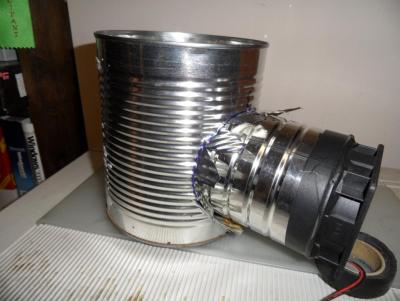
two cans -- these will be turned into iCan TLUD stove units
For more pictures of other experiments: http://www.flickr.com/photos/jockgill/

Hint: Measure the circumference of the can. Divide that by the number of holes you
want to have in your design. Use that result as the distance between hole centers.
Mark the hole centers as per the above and then make your holes.

Hint: Always make small pilot hole first and then work your way up to bigger and bigger
holes made with larger and larger tools. A set of graduated nails and spikes works
great. When in doubt, start with fewer and smaller holes. In general, primary air holes
will be smaller and secondary air holes will be much larger. The number of holes you
use and their sizes, and locations, has to be tuned for draft conditions, fuel type, fuel
form factor, and fuel size.

Perfect Char-B-Que Chicken. Juicy. Tender. No smokey taste. And no burned bits at all.Skin was also very crispy.
Cooking time: about 45 minutes. The right iCan had more primary air holes, 21, and burned out at 40 minutes.
The left iCan was complete at 48 minutes. It had only 15 holes for primary air. Tuning is important.

Biochar from the wood pellets in the iCan TLUDs at the end of the Char-B-Que. The biochar, which will be mixed with compost and then added to gardens as a soil amendment is how carbon that was in the wood pellets is sequestered. The long term sequestering of the carbon from the biomass is what makes the Char-B-Que "Carbon Negative".

Proyecto Estufa Finca An Update from Seattle

Last updated June 10, 2010

Art Donnelly, SeaChar.Org June, 2010

It was not quite 9 months ago, when I sent out an email to a small group of collaborators, with a Subject line that asked the question: "How do we get biochar stoves to Central America?" Of course, like the punch line to the old vaudeville joke, the answer is "lots of hard work". I could not have imagined 9 months ago was how rewarding all that work would feel. I want to share that feeling with all of you.

I recently returned to Seattle from Costa Rica's famed coffee producing area the Santos Zone. This was my second trip since mid- January. I have been continuing my work as a technical consultant to a clean stove/biochar project. Proyecto Estufa Finca (Farm Stove) was initiated by organic coffee farmer Arturo Segura http://www.solcolibri.com/ and the members of the local citizens group APORTES.

The goal of the Estufa Finca/ Costa Rica project is to provide safe and affordable alternative cooking technology to one of the most vulnerable populations in Central America. Each year over 100, 000 migrant agricultural workers enter Costa Rica to harvest the coffee and cocoa we enjoy. This population of families most often live without access to clean water and sanitation. They typically cook on smoky and inefficient wood fires.

The effects of this daily exposure to high levels of carbon monoxide and soot fall most heavily on women and young children. Respiratory disease is a leading cause of sickness and death in this population. This situation mirrors that of millions of families in Central America. This toll is not only felt in terms of human health, but also in it's contribution to deforestation and climate change.

I am very pleased to announce that in cooperation with the recently formed local woman's group of APORTES (the Givers), SeaChar.Org is now helping to build and distribute the clean burning, biochar producing, Estufa Finca biomass stove for the Central America market. These elegant, efficient stoves, which are designed in Seattle and made in Costa Rica, are now available for $40 US. (plus shipping) We recently had the assistance of TLUD stove inventor Dr. Paul Anderson http://www.hedon.info/Micro-gasificationWhatItIsAndWhyItWorks and a $1500 tool and materials grant from a Bloomington-Normal Illinois, Rotary Club . This has allowed us to put together a temporary workshop, where three women can work and to stock supplies for 65 stoves. The initial goal of our joint Seattle/ Costa Rica project is to reach the estimated 1,500 seasonal agricultural workers homes, with a clean, safe efficient cook stove. A donation of $40 pays for a stove for a coffee pickers family.

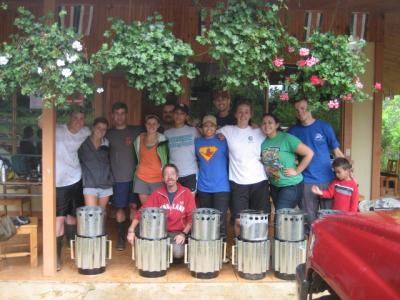
The women's owned stove workshop is located in Santa Maria de Dota, Costa Rica. Working from patterns, guides and jigs, which we developed as a team, the women can produce completed stoves and stove "kits". Working with partners like Santos Tour http://www.santostour.net/ , the kits are being assembled and paid for by visiting student volunteers, during one-day "Stove- building" workshops. APORTES organizer and workshop leader Carolina Abarca, is getting stoves built and Estufa Finca global ambassadors. These are high quality appliances, assembled with simple hand tools and rivets. The completed stoves are tested and then donated to the Proyecto Estufa Finca, to be leased for home placement with migrant coffee picker families. The Estufa Finca is both fuel flexible and fuel efficient. These easy to use TLUD-style, stoves burn with 65% lower emissions of carbon monoxide and soot, than a traditional, open three-stone fire. They convert dry biomass waste into a clean gas flame and valuable charcoal. Interest and demand for both the stoves and workshops are growing. We are getting inquiries from around Costa Rica and around the world. The potential for widespread good and a vibrant woman's owned business seem imminent.

To realize this potential is going to take your critical early support. Your investment of time, money or expertise at this early phase will ensure our success. The Seattle based non-profit, Seattle Biochar Working Group, is providing carbon negative technology development, testing, training and fund raising assistance for Proyecto Estufa Finca. You can make a tax deductible donation using PayPal at http://www.seachar.org/ or contact art.donnelly@seachar.org for information on how to buy stoves and to learn how you can help us reinvent fire.

Pura Vida,

Art Donnelly
SeaChar.Org
Proyecto Estufa Finca
--
"it's time to get positive about negative thinking"

1G Toucan TLUD for Biochar Jan 2010

Last updated February 14, 2010

by Hugh McLaughlin, PhD, PE, Alterna Biocarbon Inc., January 2010 Version

Download the Instructions: 1G Toucan TLUD for Biochar Jan 2010 - final.pdf (630kb)

Two Barrel TLUD Construction

Last updated December 03, 2009

R. Diermair November, 2009

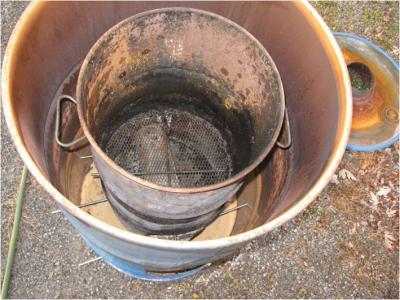
Attached as a Power Point file and a PDF is a nicely illustrated guide to creating a TLUD (top lit up-draft) biochar retort with two barrels. As he notes, understanding the TLUD is critical to getting reliable, clean take a look at our other TLUD References for more guidance.

The BioChar Workshop at Pony Farm

Last updated June 23, 2009

Peter Hirst, Pony Farm in Temple, New Hampshire, on May 9, 2009.

Follow the link for some great video from the recent Biochar Roundtable at the Lodge at Pony Farm in Temple, New Hampshire, on May 9, 2009.

Pony Farm Biochar Workshop

http://thinkingglobalactinglocal.com/biochar-workshop-may-9-2009.html

A handy kiln for making charcoal from urban leaf litter

Last updated November 06, 2008

A handy kiln for making charcoal from urban leaf litter
Appropriate Rural Technology Institute (ARTI), Pune, India www.arti-india.org
Single Barrel Charcoal Kiln

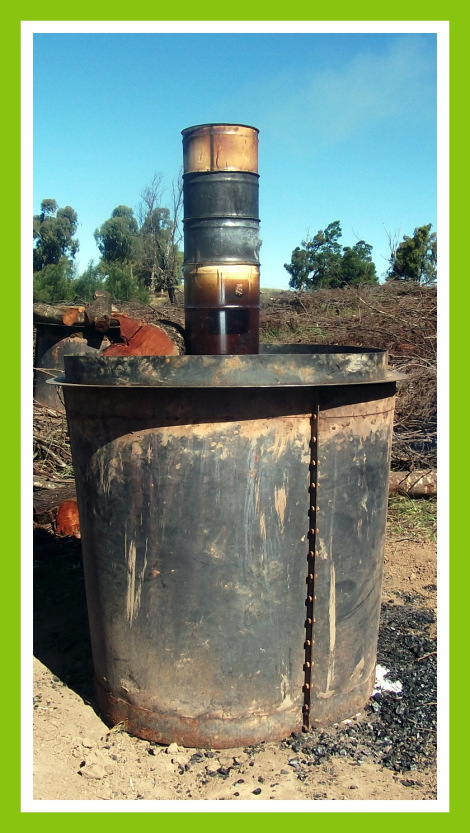
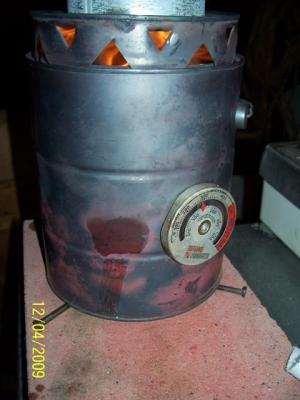
I can tell you how to make char out of your burnable organic waste. The simplest device is a top-lit updraft kiln. It consists of a vertical cylinder, having relatively small holes near its base for primary air. You fill the cylindrical body of the kiln with the material to be charred and then light it from the top. Once the fire gets going, you place a lid on the cylinder. There is a chimney built into the lid. The lid does not sit flush on the kiln, but there is a gap between the lid and the kiln. The draft created by the chimney sucks secondary air into the chimney, where it gets mixed with the pyrolysis gas to burn it. The biomass burns downwards, leaving a layer of charcoal on top. As the primary air comes upwards, it meets the burning front which traverses downwards. The burning biomass utilises all the oxygen in the primary air, so that the air going up through the layer of char has only carbon dioxide, carbon monoxide, nitrogen and the pyrolysis gas left in it. As there is no oxygen left in the updraft air, it cannot burn the char that has formed above the burning biomass.The pyrolysis gas and carbon monoxide burn in the chimney, because of the secondary air that is sucked in through the gap between the chimney and the kiln. You have to find out by trial and error, how long it takes to char the material loaded in the kiln. After that much time is over, you remove the lid, and extinguish the fire by sprinkling water over the burning material.

This particular device is portable and manually operated. There are larger charring kilns, based on the oven and retort process. Prof. Yuri Yudkevich, a Russian scientist, has made them for charring useless material generated by the timber industry in Russia.

We are already using both types of kilns under field conditions in India for charring agricultural waste as also urban waste.

We have a video CD that describes the kilns and you can fabricate them by watching the video CD. Our web site www.arti-india.org would show you how to get our CDs by paying us through Pay Pal.

Yours
A.D.Karve

See also:
Briquetted Charcoal from Sugarcane Trash

Syndicate content