USA

Gasifier Charcoal as a Substitute for Vermiculite in Container Growing Media

Last updated November 08, 2009

Gasifier Charcoal as a Substitute for Vermiculite in Container Growing Media
Tom Miles, August 22, 2009
P Pine Seedlings in 25% BiocharP Pine Seedlings in 25% Biochar
Our second trial of biochar as a substitute for vermiculite in container media for growing tree seedling has proved successful. These tests are by a private nursery to determine if charcoal from a gasifier heating system can be used in container growing media.

Last year weathered charcoal was collected from forest fire burns, milled, and used as a direct substitute for vermiculite in up to 50% of the container mix. Some of those trees have been retained in containers for a second year and still look good. At that time the forest tree nursery concluded that the biochar could be used for up to 50% of the mix with some adjustments to plant nutrition.
http://terrapreta.bioenergylists.org/charcoalmedia

This year the nursery filled a larger sample with media containing 25% biochar from a gasifier.

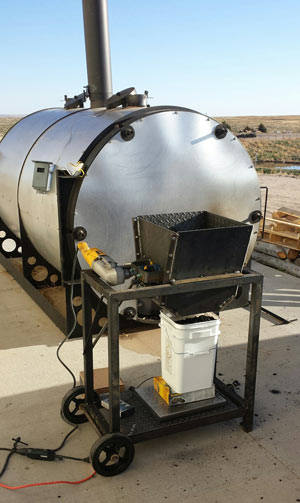
During gasification the char is made as wood (mixed Pine and Douglas Fir from the California Coast range) is subjected to temperatures of 1000 C (1832 F) in an oxidizing atmosphere and 850C (1562 F) in a reducing environment. Tars are volatilized and combusted to carbon dioxide and water. Tars are completely consumed in the process. The CO2 reacts with the devolatilized charcoal to form a gas rich in carbon monoxide and hydrogen. The gas will be used in place of propane to heat greenhouses.

Water is condensed from the gas. The recovered water (condensate) could probably be used to supplement irrigation. It is clear to light lemon colored and has a faint odor. It has a pH of 7.1 and is highly saline with an electrical conductivity (EC) of 5.1 mS/cm. It will be analyzed for composition.

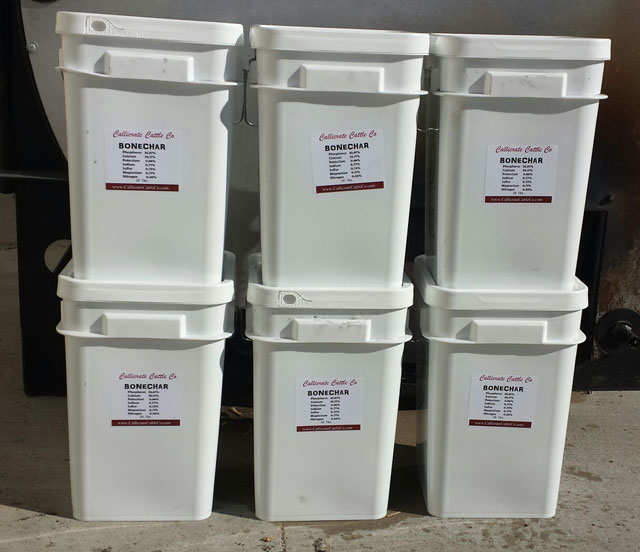
Less than 5% of the dry fuel is recovered from the gasifier as a charcoal residue. The charcoal residue is still being characterized. It is small in size and puffy with powdery fines that are like a confectioner’s sugar. Due to the conditions of carbonization it is likely that it has very low labile (volatile) carbon, high surface area, high CEC and high pH. (High pH does not appear to have affected nutrient availability in previous trials even up to 50% charcoal in the container mix.) It was tested at the nursery as biochar.

Ponderosa pine seedlings grown in 25% gasifier charcoal since June were identical in root development and plant growth as those grown in the vermiculite mix. Two of each are shown in the attached image.

Future trials will use biochar in media to grow other tree species.
Condensate from Wood GasCondensate from Wood Gas

Third year results, Fourth Corner Nurseries soil/biochar study

Last updated August 01, 2009

Third year results: Fourth Corner Nurseries Soil/Biochar Study
Richard Haard, Plant Propogationist, July 31, 2009

This study predates the coining of the term biochar and I claim grandfather rights to use the word charcoal.

Third year results, Fourth Corner Nurseries soil/biochar study

Summer 2009 Biochar plot studySummer 2009 Biochar plot studyresults are showing some trends I have had difficulty measuring with the last two years of cropping these plots. The use of buckwheat, a short season cover crop plant makes a visual view of performance reflecting nutrition, quite vivid. In spite of the dips in the plots due to deer browse.

This image is a merged sequence of pictures taken at same distance. Background may be confusing because of perspective. These plots are the first set, (south end), of treatments laid out in a systematic way. Results from the north set are similar and will be presented in a final poster

This plot study included: compost ( a wood based commercial compost of sewage solids)
charcoal 1 ( about 1/2 inch minus), charcoal 2 ( powder from John Flottvik's pyrolyser).
fertilizer: a complete, chemical fertilizer

These additives were only used once. In 2008 and 2007 all plots were given a light treatment of urea, none in 2009, although the early spring cover crop was legume.

Quirks shown in pictures: upper right dips in each of 3 plots due to deer browse. Bump in production in compost plot that is consistent with every year and a odd drop in plant height in fertilizer plus charcoal 2 plot. Also the soil analysis of the north set of plots is better than the south part, and this also shows in the charcoal 2 only plot at the north end of the south set.

This said there are some interesting trends showing in this third year of this experiment.

Compost is still showing benefit even after continuous cropping.

This year the strategy was to duplicate our farm soil management strategy of cover cropping after two years to build up organic matter and burn weed seed. First cover crop in March was vetch and fava bean. Buckwheat was planted immediately in May and will be tilled in within a few weeks to be replaced with another cover crop (oats or barley) before planting with transplanted native plants next spring.

The compost + charcoal and compost + fertilizer + charcoal plots are showing the best growth of all the plots. This to me is an indication of synergism or an additive effect of charcoal in combination with compost.

Fertilizer series. The first 2 years of cropping the benefit of fertilizer was shown. Now I am seeing a decline in production in these plots. The compost plus fertilizer plot mysteriously is not better than compost only.

Control set. Interesting that the growth in the charcoal 1 is less than the control. Perhaps indication the charcoal errr biochar is removing nutrients from the soil. As mentioned above charcoal 2 control set is in beginning of higher nutrition soil.

This image is original size that allows scrolling close up.
Here is an image that shows all plots full screen.

Rich Haard, Propagation Manager
Fourth Corner Nurseries
Bellingham, Washington

The BioChar Workshop at Pony Farm

Last updated June 23, 2009

Peter Hirst, Pony Farm in Temple, New Hampshire, on May 9, 2009.

Follow the link for some great video from the recent Biochar Roundtable at the Lodge at Pony Farm in Temple, New Hampshire, on May 9, 2009.

Pony Farm Biochar Workshop

http://thinkingglobalactinglocal.com/biochar-workshop-may-9-2009.html

Agricultural Applications for Biomass Pyrolysis

Last updated February 24, 2009

Agricultural Applications for Biomass Pyrolysis
Jon Nilsson, Carbon Char Group, NJ, Presentation to UN, November 2008

Agricultural ApplicationsAgricultural Applications

Soil Scientist, Jon Nilsson of the Carbon Char Group presented Agricultural Applications for Biomass Pyrolysis at the UN Commission on Sustainable Development Partnerships Fair earlier this year. This was part of the Partnership in New Technologies for Small Island Developing States. The powerpoint of this presentation is available here.

2009 Events Calendar Carbon-Negative Northeast Network and Biochar FAQ

Last updated November 28, 2008

2009 Events Calendar Carbon-Negative Northeast Network
http://tech.groups.yahoo.com/group/carbon-negative
Communities Confronting Climate Change, Energy Independence and Food Security
David Yarrow,November 2008

Carbon NegativeCarbon Negative

2009 Events Calendar
final version. see attached .pdf file
one page

i am assembling information into two FAQ sheets, one on biochar, the other on carbon-negative.

Attached is my first draft of the biochar FAQ.

for a green & peaceful planet,

David Yarrow
Turtle EyeLand Sanctuary
44 Gilligan Rd, East Greenbush, NY 12061
cell: 518-881-6632
www.championtrees.org
www.OnondagaLakePeaceFestival.org
http://tech.groups.yahoo.com/group/carbon-negative
www.farmandfood.org
www.SeaAgri.com

Biochar Trial 2 - Design [Draft]

Biochar Trial Photos
Empty Planting Trays on Rack Fine Wet Processed Charcoal Settling in Flask Bamboo Feedstock Softwood Chip Feedstock
Charcoal Production in Woodgas Stoves Charcoal Grades Char Measurement  
Amended Pots Prior to Mixing Pots Mixed and Seeds Sown Growth After 9 Days Wheat and Peas Seperated to Avoid Shading

Some design features below:
Exploring interaction effects of feedstock type, soil, char application
rate, crop species, char size, fertilization, and mycorrhizal fungi.
No repetition (n=1), this loses the ability to assign a statistical
significance level to results, but allows more interactions (96 unique
combinations, 96 pots) to be tried given limited resources.

Charcoal produced in WoodGas stoves.
Char yield 12-18% (char mass/air dry biomass mass) (ie not adjusted to conventional dry weight yield unit, yet).
Fine Char - Blended and sieved to 230 mesh (<63 micron).
Coarse Char - Blended and sieved to between ~24 mesh - 8 mesh.
Fertilizer - 4-4-4 NPK Organic (bone meal, feather meal...)
Potting Soil - Potting Mix
Sandy Soil - Mixture of Horticultural Sand and Sandy Loam from Central Valley

Pots arranged in random spatial order (to randomize light/watering variation). Trays rotated to limit effects of light/watering variation.
Automatic drip emitter watering. Pots grown in enclosed cage outdoors.

Blocks - ( 8 pots/block)
    Fertilizer {Yes,No}
    Plant {Wheat, Pea}
    Soil {Sandy, Potting}

Blocks - (12 blocks * 8 pots/block = 96 pots)
    B1 -    Char (0 g)
    B2 -    Char (1 g, Pine, Fine)
    B3 -    Char (1 g, Pine, Coarse)
    B4 -    Char (1 g, Bamboo, Fine)
    B5 -    Char (1 g, Bamboo, Coarse)
    B6 -    Char (5 g, Pine, Fine)
    B7 -    Char (5 g, Pine, Coarse)
    B8 -    Char (5 g, Bamboo, Fine)
    B9 -    Char (5 g, Bamboo, Coarse)
    B10 -   Char (0 g) + Mycorrhizae
    B11 -   Char (5 g, Pine, Coarse) + Mycorrhizae
    B12 -   Char (10 g, Pine, Coarse)
 

Effects of Varied Soil Composition (Char, Sand, Potting Mix) on the Growth of Radish Starts

Last updated March 10, 2009

Bear Kaufmann. Initially posted April 7, 2008. Updated August 5, 2008.


Images showing trial preparation and radish germination
(Select image to enlarge in Gallery.)

Materials/Methods

Char was Lazzari Brand mesquite BBQ char (due to availability), crushed and screened to 1/8".
No nutrients were added to the char itself or to the soil.
Soil was FoxFarm OceanForest Potting Soil.
Sand used was horticultural sand.
No mycorrhizal fungi were added.
Mixtures range from 0-100% sand, soil, and char in ~16% increments by volume. 90 pots total. 28 combinations with 3 pots each + 6 additional pots at 33%/33%/33% composition. Pots were placed randomly within the tray. Tray was rotated 180° occasionally.
Plants were watered daily by a drip irrigation system.
Plants were removed from pots ~1 month after first watering. Soil was rinsed from roots and roots were patted dry with a towel. Wet weight of roots+shoots was measured (Acculab VI-3mg, 0.001 g precision).

Box Plots Showing Effect of Composition Across Three Transects
Figure 1. Box Plots Showing Effect of Composition Across Three Transects

Figure 2. Pictures of Radishes at Important Compositions

Results

Plant growth was stunted even for the best preforming plants, likely due to the small pot size. Leaf color varied across different compositions.
A mixture of 33% charcoal and 67% soil had the best growth (176% of pure soil). Aside from mixtures around this level (Figure 1b), high levels of charcoal showed a generally negative effect on plant growth (Figure 1c).

Discussion

The positive interaction effects of charcoal and soil (Figure 1a,1b) are interesting. Assuming charcoal itself provides no integral nutrients to the soil (eg. nitrogen), increasing amounts of charcoal reduce nutrients available from the soil mixture. The effects at 33% char/67% soil, however, show beneficial effects. This could be explained by increased mineralization rates caused by the charcoal causing soil nutrients to be more available to plants. Beyond 33%, the Cation Exchange Capacity of the charcoal may have held the nutrients produced by mineralization, making them less plant available. Since the charcoal was not amended/soaked in a nutrient bearing solution it likely had a low Base Saturation leading to adsorption of nutrients as they became available. Other potential explanations for increased growth along the soil/char transect include alterations to pH or limiting nutrients (eg potassium(?)) provided by the charcoal. The speculative mineralization/CECi model could also explain the effects seen along the sand/char transect. Here, since the sand lacks organic materials and bound nutrients for soil microorganisms to make plant available, the increasing unsaturated CEC may have made any nutrients less plant available.

Author: Bear Kaufmann bear at ursine-design.com

Pyrolysis Reactor Tower Assembly

Last updated March 10, 2009

Pyrolysis Reactor Tower Assembly
Sean Barry, April 21, 2008

I assembled the Pyrolysis Reactor Tower today. I had it fabricated over the winter.

Regards,

SKB

The Charcoal Vision

Last updated April 13, 2008

The Charcoal Vision: A Win–Win–Win Scenario for Simultaneously Producing Bioenergy, Permanently Sequestering Carbon, while Improving Soil and Water Quality
David Laird, USDA, ARS, National Soil Tilth Laboratory, April 12,2008
In, Agronomy Journal • Volume 100, Issue 1 • 2008

ABSTRACT
Processing biomass through a distributed network of fast pyrolyzers may be a sustainable platform for producing energy from biomass. Fast pyrolyzers thermally transform biomass into bio-oil, syngas, and charcoal. The syngas could provide the energy needs of the pyrolyzer. Bio-oil is an energy raw material (∼17 MJ kg−1) that can be burned to generate heat or shipped to a refinery for processing into transportation fuels. Charcoal could also be used to generate energy; however, application of the charcoal co-product to soils may be key to sustainability. Application of charcoal to soils is hypothesized to increase bio-available water, build soil organic matter, enhance nutrient cycling, lower bulk density, act as a liming agent, and reduce leaching of pesticides and nutrients to surface and ground water. Th e half-life of C in soil charcoal is in excess of 1000 yr. Hence, soil-applied charcoal will make both a lasting contribution to soil quality and C in the charcoal will be removed from the atmosphere and sequestered for millennia. Assuming the United States can annually produce 1.1 × 10⁹ Mg of biomass from harvestable forest and crop lands, national implementation of Th e Charcoal Vision would generate enough bio-oil to displace 1.91 billion barrels
of fossil fuel oil per year or about 25% of the current U.S. annual oil consumption. Th e combined C credit for fossil fuel displacement and permanent sequestration, 363 Tg per year, is 10% of the average annual U.S. emissions of CO2–C.

Syndicate content