Making Charcoal

MAKING BIOCHAR: with Peter Hirst of New England Biochar

Last updated October 10, 2009

MAKING BIOCHAR: with Peter Hirst of New England Biochar

Many thanks to George Packard of Parrot Creek Productions, Warner, New Hampshire for some really fine work. This is the short version of greater works in progress. Very well done by George and much appreciated.

Peter Hirst

Biochar Trial 2 - Design [Draft]

Biochar Trial Photos
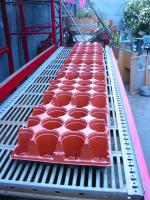
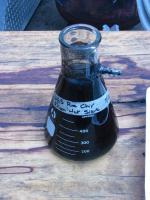
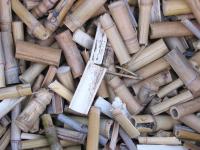
Empty Planting Trays on Rack Fine Wet Processed Charcoal Settling in Flask Bamboo Feedstock Softwood Chip Feedstock
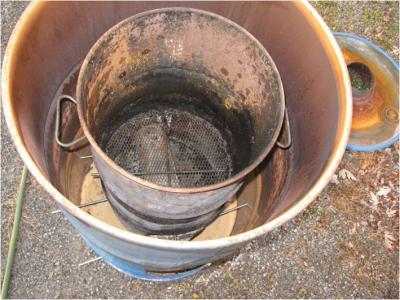
Charcoal Production in Woodgas Stoves Charcoal Grades Char Measurement  
Amended Pots Prior to Mixing Pots Mixed and Seeds Sown Growth After 9 Days Wheat and Peas Seperated to Avoid Shading

Some design features below:
Exploring interaction effects of feedstock type, soil, char application
rate, crop species, char size, fertilization, and mycorrhizal fungi.
No repetition (n=1), this loses the ability to assign a statistical
significance level to results, but allows more interactions (96 unique
combinations, 96 pots) to be tried given limited resources.

Charcoal produced in WoodGas stoves.
Char yield 12-18% (char mass/air dry biomass mass) (ie not adjusted to conventional dry weight yield unit, yet).
Fine Char - Blended and sieved to 230 mesh (<63 micron).
Coarse Char - Blended and sieved to between ~24 mesh - 8 mesh.
Fertilizer - 4-4-4 NPK Organic (bone meal, feather meal...)
Potting Soil - Potting Mix
Sandy Soil - Mixture of Horticultural Sand and Sandy Loam from Central Valley

Pots arranged in random spatial order (to randomize light/watering variation). Trays rotated to limit effects of light/watering variation.
Automatic drip emitter watering. Pots grown in enclosed cage outdoors.

Blocks - ( 8 pots/block)
    Fertilizer {Yes,No}
    Plant {Wheat, Pea}
    Soil {Sandy, Potting}

Blocks - (12 blocks * 8 pots/block = 96 pots)
    B1 -    Char (0 g)
    B2 -    Char (1 g, Pine, Fine)
    B3 -    Char (1 g, Pine, Coarse)
    B4 -    Char (1 g, Bamboo, Fine)
    B5 -    Char (1 g, Bamboo, Coarse)
    B6 -    Char (5 g, Pine, Fine)
    B7 -    Char (5 g, Pine, Coarse)
    B8 -    Char (5 g, Bamboo, Fine)
    B9 -    Char (5 g, Bamboo, Coarse)
    B10 -   Char (0 g) + Mycorrhizae
    B11 -   Char (5 g, Pine, Coarse) + Mycorrhizae
    B12 -   Char (10 g, Pine, Coarse)
 

Making charcoal - open fire

Last updated February 07, 2009

I was surprised that there were no how to's for charcoal productions without the need for kilns, drums etc, so thought this might be of interest to some as a trial technique. It is not very efficient by way of volume of charcoal to volume of biomass to start, but can be useful if you have quantities of garden waste such as prunings, bark, leaves etc. This type of stuff normally goes into green waste, or needs chipping to compost or use as mulch as it is too big for compost bin.

This is a process I have used which requires only an open fire or fire pit, shovel or rake and water (hose or steel buckets with water). It is a minor modification of the techniques used when cooking using the camp oven - which only uses coals instead of flame. Instead of transferring the coals to the oven pit, they are wetted down to stop burning, and create charcoal.

Basic technique is the same as if you want to make a fire for a barbeque, or camp fire. To avoid smoke use only dry fuel. In this example we had large quantities of prunings, small branches, dry leaves, bark etc. which needed to be removed before fire season. Most fuel was 5-20mm diameter. Got good results with quantities of bark and dried leaves in another burn.

Start with a small fire, and constantly add fuel - trying to keep the fire relatively small without too much flame.

Once the initial fuel burns, either add more fuel or let it die down to a small pile with coals, often covered with a layer of ash. Once the fire stops producing smoke, or flame, it is pretty much ready. See photo below.


Camp fireCamp fire

This is fairly advanced into the fire, showing more fuel added to fire. Below is pretty much at the end of burning all available fuel.


Ready to remove coalsReady to remove coals


Once all the fuel has burnt, it is now a bit cooler and easier to remove the coals to damp them down, or just wet the entire fire down with hose - thoroughly soak the fire, raking to ensure you have wet it all down. The photo below left is the fire cone opened up to remove coals. In this case I did not have a hose nearby, but steel drums full of water I shovelled coals into. The drums are handy for this as they can then be used to carry the charcoal to the garden area - and charcoal can be crushed in the tin.


Removing coalsRemoving coals


A bucket full of charcoalA bucket full of charcoal


Ready to useReady to use


This shows a shovel full of charcoal after wetting down. I then drain the bucket or transfer from wetted fire pit to bucket, and can be crushed and used straight away. Using garden prunings rather than large branches results in smaller charcoal to start with, and easier to crush. In this case, I got around 200 litres volume of charcoal.

As yet I have not planted anything into the vegie garden beds with the charcoal added, but will now be retaining all green waste to make biochar.

Simple charcoal kiln

Last updated April 27, 2008

Simple charcoal kiln
Folke Gunther, April 24, 2008

A wonderfully simple method for making charcoal at home or on the allotment.

"http://picasaweb.google.se/folkeg/TheSimplestOfTheSimple

--

There is a wide demand for charcoal kilns to be used by anybody having an allotment or garden sized plot. The idea of making char of surplus biomass instead of firing it is widely spread in Latin America (and Japan?). Burning the pyrolysis gasses instead of emitting them makes the method comparatively safe, although not efficient regarding their potential utilisation of gasses.

I agree that his is a very small scale method, bu imagine 2 billion people having it, making 1 kg char a week for their lots. That would imply about 0.1 Gt annually, or 5% of what would be necessary to sequester for making a change.

Naturally, this is not the method to save the world from entering a tipping point, but it could well be of some help.
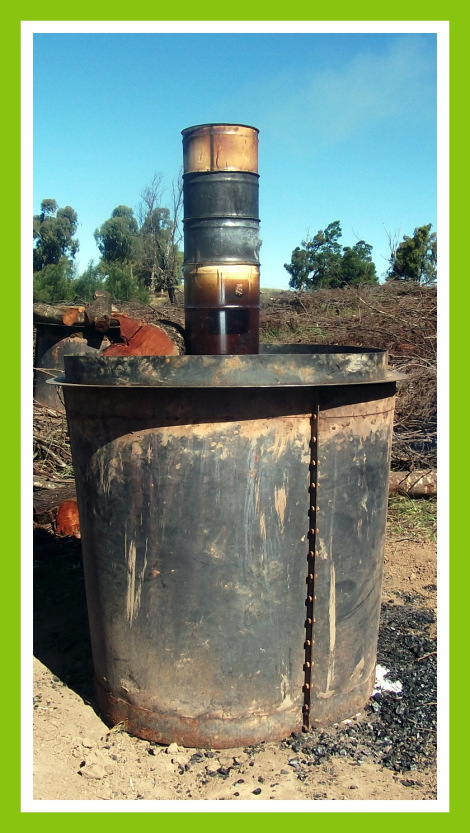
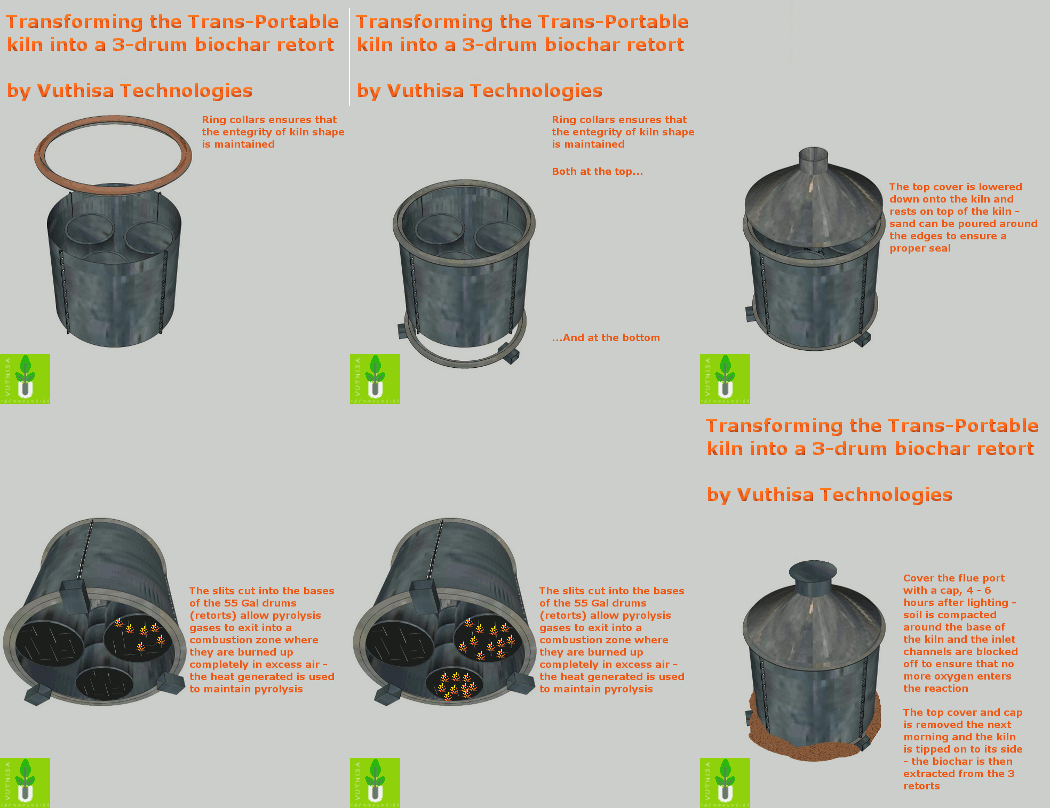
Besides, making 50 kg of char annually, would certainly make a change for the production form a normal sized allotment, certainly so if you go on for several years.

I don't agree that using barrels for making char automatically would imply methane emissions. That must certainly be a consideration depending of the charring method, not the material used.

----------------------------------------
Folke Günther
Kollegievägen 19
224 73 Lund
Sweden
Phone: +46 (0)46 141429
Cell: +46 (0)709 710306
URL: http://www.holon.se/folke
BLOG: http://folkegunther.blogspot.com/

How to Make Charcoal

Last updated February 12, 2009

How to Make Charcoal
Robert Flanagan, SAFFE, January 30, 2008

I've just been playing around with my natural draft stove to see how easy it would be to use it for cooking and making charcoal http://www.youtube.com/watch?v=Y5OAkmum7gU&feature=channel_page .
I fed some extra fuel in the side so show the pyrolysis reaction taking place.

CHARCOAL (how to make charcoal in a drum)

Last updated February 09, 2008

The author, Gary Gilmore, explains how he designed a charcoal retort from 55 gallon drums. This is a smoke free design also the flare could be put to use. See below link: Charcoal by Gary Gilmore

Charcoal from Smallwood

Last updated January 02, 2008

Charcoal From Smallwood
in "Niche Marketing Strategies for Products from Small-Diameter Timber
A.L. (Tom) Hammett, Professor, Phil Radtke, and Robert L. Smith, Professor and Extension Specialist, Department of Wood Science & Forest Products, Virginia Tech, Blacksburg, VA, Smallwood 2006
Ready for BagReady for Bag

Charcoal Making Videos

Last updated July 12, 2007

Charcoal Making Videos
YouTube, July 2007

SAFFE, Huangzhou, China Renewable Carbon Negative Energy

ioherbalalchemy, USA, Making Charcoal

Making Charcoal in Ivory Coast, West Africa March 18, 2007 ML Murphy

Use the Iwasaki charcoal-making kiln to make charcoal from forest thinnings.

Last updated August 17, 2007

Use the Iwasaki charcoal-making kiln to make charcoal from forest thinnings.
Iwasaki MASATO, Ashikaga Institute of Technology College, Tochigi Prefecture, Japan

The Iwasaki charcoal kiln is made from two steel drum cans.
Since high temperature is used, it takes a very short time to make the charcoal.
Wood (diameter<5cm) charcoal takes less than 5 hours to make.
Bamboo charcoal takes less than 3 hours to make.
This charcoal-making kiln can make be used to make charcoal from corn cobs,

India: Making Charcoal from Prosopis Juliflora

Last updated January 26, 2009

India: Making Charcoal from Prosopis Juliflora
N. Sai Bhaskar Reddy, India April 30, 2007
Prosopis Juliflora Stacked for Charcoal MakingProsopis Juliflora Stacked for Charcoal Making

Syndicate content