Australia: Healthy Soils for Sustainable Farms July 2007

Last updated November 16, 2008

Health Soils for Sustainable Farming Proceedings July 2007
Australia.

Farming soils in the southern agricultural region of Western Australia – Gradyn Wilcox
14 . . . . Healthy soils – lessons learned from history can take us ‘back to the future’ –Tim Reeves
18 . . . . The international perspective – knowledge gained through long term trials and established agriculture –Olle Andren
22 . . . . Prioritising the properties of soil structure – David McKenzie
27 . . . . You and your soil – getting the chemistry right in your relationship – Chris Dowling
38 . . . . Soil biology – Dan Murphy
46 . . . . Keeping nitrogen under control – Charlie Walker
55 . . . . Landscape changes start with changes in ourselves – David Marsh
64 . . . . Snapshot – Peter Jackson
67 . . . . Defining soil carbon – Jeff Baldock
74 . . . . Management practices for building soil carbon – John Kirkegaard
79 . . . . Decision support for identification and management of subsoil constraints – Yash Dang
89 . . . . What do some of the new tools tell us about carbon? – Pauline Mele
92 . . . . Carbon farming – facts and fiction – Peter Grace
100 . . . Australian farming practices – Better for soil, better for productivity – Alan Umbers
111 . . . Learning from long term experiments – what do they teach us? – Rob Norton
120 . . . Crunching the numbers - Brooke White
130 . . . A farmer perspective – does it pay to be healthy? - Martin Hockey
131 . . . How far has soil health come in the cotton industry? – Guy Roth
140 . . . Sheep meat industries – supporting soil health – Bob Hannam
146 . . . What is the dairy industry doing to ensure it sustains its soils? - Warwick Dougherty
150 . . . Soil health – what’s going on in horticulture? – Doris Blaesing
155 . . . Bridging the gap between scientists and farmers – Albert Rovira

Chaotech Pty Ltd

Last updated July 19, 2008

Chaotech Pty Ltd.
Rex Manderson [rexm@chaotech.com.au], Australia, July 2008

BiogasWorks PilotBiogasWorks Pilot

This site www.biogasworks.com is the portal for the carbon cycle activities of Chaotech Pty Ltd.

Our slow carbonization pilot plant is now rated 40 to 60kg charcoal per hour for lightweight feed such as sawdust. The specification particle size limit is 8mm largest dimension. Process simulations have produced a yield of ~40% char on a dry mass basis with ~80% total carbon content in the char.

See: Biogas works

Making charcoal - open fire

Last updated February 07, 2009

I was surprised that there were no how to's for charcoal productions without the need for kilns, drums etc, so thought this might be of interest to some as a trial technique. It is not very efficient by way of volume of charcoal to volume of biomass to start, but can be useful if you have quantities of garden waste such as prunings, bark, leaves etc. This type of stuff normally goes into green waste, or needs chipping to compost or use as mulch as it is too big for compost bin.

This is a process I have used which requires only an open fire or fire pit, shovel or rake and water (hose or steel buckets with water). It is a minor modification of the techniques used when cooking using the camp oven - which only uses coals instead of flame. Instead of transferring the coals to the oven pit, they are wetted down to stop burning, and create charcoal.

Basic technique is the same as if you want to make a fire for a barbeque, or camp fire. To avoid smoke use only dry fuel. In this example we had large quantities of prunings, small branches, dry leaves, bark etc. which needed to be removed before fire season. Most fuel was 5-20mm diameter. Got good results with quantities of bark and dried leaves in another burn.

Start with a small fire, and constantly add fuel - trying to keep the fire relatively small without too much flame.

Once the initial fuel burns, either add more fuel or let it die down to a small pile with coals, often covered with a layer of ash. Once the fire stops producing smoke, or flame, it is pretty much ready. See photo below.


Camp fireCamp fire

This is fairly advanced into the fire, showing more fuel added to fire. Below is pretty much at the end of burning all available fuel.


Ready to remove coalsReady to remove coals


Once all the fuel has burnt, it is now a bit cooler and easier to remove the coals to damp them down, or just wet the entire fire down with hose - thoroughly soak the fire, raking to ensure you have wet it all down. The photo below left is the fire cone opened up to remove coals. In this case I did not have a hose nearby, but steel drums full of water I shovelled coals into. The drums are handy for this as they can then be used to carry the charcoal to the garden area - and charcoal can be crushed in the tin.


Removing coalsRemoving coals


A bucket full of charcoalA bucket full of charcoal


Ready to useReady to use


This shows a shovel full of charcoal after wetting down. I then drain the bucket or transfer from wetted fire pit to bucket, and can be crushed and used straight away. Using garden prunings rather than large branches results in smaller charcoal to start with, and easier to crush. In this case, I got around 200 litres volume of charcoal.

As yet I have not planted anything into the vegie garden beds with the charcoal added, but will now be retaining all green waste to make biochar.

The multiplication factor

Last updated July 05, 2008

The multiplication factor
Richard Douthwaite, richard@douthwaite.net, July 5, 2008

Dear All:

Everyone on this list subscribes because he or she believes that biochar has the potential to ease the climate crisis. But how great is that potential? It seems pretty clear that we will never be able to bury enough biochar each year to match the amount of fossil carbon being taken out of the earth. In any case, what would be the point? Instead of digging up coal and burning it we could burn the biochar instead.

So biochar's potential usefulness depends on what I call the multiplication factor - the amount by which the incorporation of biochar in the soil either leads to more carbon being sequestered or prevents the release of greenhouse gases that would have been emitted had it not been put in the soil. Let's look at these in turn.

1. Additional carbon sequestration.

We know that biochar increases the fungal and microbial content of the soil. Both contain carbon, and therefore represent an increase in the soil's carbon content. The fungi develop because the plants growing in the soil send sugars down their roots on which the fungi feed and, in return, the fungi release the nutrients locked up by the biochar and make it available to the plant. So the plants themselves sequester carbon. But how much? What we need to know is the weight of the carbon in the fungi and microbes in comparison with the weight of the biochar. Does anyone have a figure? And, as plants grow better on biochar soil, we could also include the carbon held by their bigger roots and, if they are semipermanent, locked up in their greater above-ground stems and foliage.

2. Reduced greenhouse emissions

The use of biochar increases the amount of nitrogen-fixing bacteria in the soil. This makes it necessary for the farmer to apply less. So does the fact that the char will hold a lot of whatever external nitrogen is applied, whether in dung/slurry or in artificial fertiliser, preventing it being leached away and also being broken down into nitrous oxide, a powerful greenhouse gas. Nitrous oxide emissions currently account for approximately one third of GHG emissions from agriculture in Ireland. Biochar also reduces the release of methane from the soil and, because it holds phosphate ions, reduces the need for applications, thus saving the energy required by the mining, preparation and delivery process. In short, biochar both reduces greenhouse emissions from the land itself and from the agricultural chemical supply chain. There may also be other greenhouse emissions savings I've not considered.

The two effects are different analytically. The additional carbon sequestration seems likely to be a once-off effect - the amount of fungi, roots etc in the soil will increase for a few years and then level off. However, the lower annual greenhouse emissions from soil treated with biochar, and from the agricultural chemical supply chain that feeds it, will persist for many years. The total tonnage of emissions saved over, say, a century, by one tonne of biochar could be huge.

We really need to be able to put figures on the tonnage of carbon likely to be taken out of the air by putting biochar into different soils in different parts of the world, and with different types of plants being grown on them. We need figures too for the emissions savings that biochar can achieve in different types of farming so that we can work out where, from a climate perspective, the limited amount of biochar likely to be available should best be applied.

Is anyone working in this area? It would be great if this list was able to come up with some rough figures for the two effects as, if no academics are active already, it might spur one of them to become so.

Best wishes,

Richard.

See discussion at: biochar-climatechange@yahoogroups.com

Australian Biochars

Last updated June 21, 2008

Australian Biochars
Jerome Matthews, June 21, 2008
Australian BiocharsAustralian Biochars

Hi There,

We are commercial suppliers of biochars and just thought that you may be interested as we don't think that anyone else is yet producing to our levels. We're happy to receive queries.

You may find us at http://www.biochars.com

Best regards.

Jerome Matthews

Puzzle

Last updated November 06, 2008

Puzzle
Max Henderson, June 15, 2008

Floating Char
Floating Char

New address to the simple kiln

Last updated November 06, 2008
in

New address to the simple kiln
Folke Günther

Simple Charcoal Kiln Burning

Simple Charcoal Burn

A complete description of the simple charring methods for home garden is now at
http://www.holon.se/folke/carbon/simplechar/simplechar.shtml

I saw that there is an older address at the terrapreta list. I use it to cook the dinner wok at the same time as I am burning the charcoal.

YS
FG

--
NB :Send your mails to folkeg@gmail.com, not to holon.se
----------------------------------------
Folke Günther
Kollegievägen 19
224 73 Lund
Sweden
Phone: +46 (0)46 141429
Cell: +46 (0)709 710306
URL: http://www.holon.se/folke
BLOG: http://folkegunther.blogspot.com/

More Trial Data With Explanatory Photos

Last updated May 26, 2008

More Trial Data With Explanatory Photos
Max Henderson May 26, 2008
Kiln ExternalKiln External
Kiln Fire Under DrumKiln Fire Under Drum

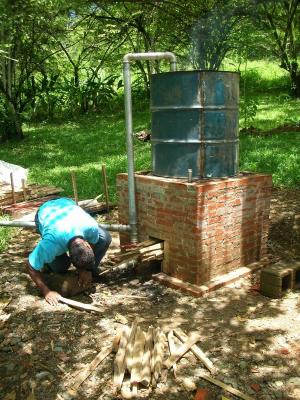
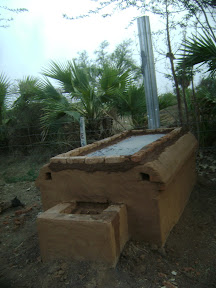
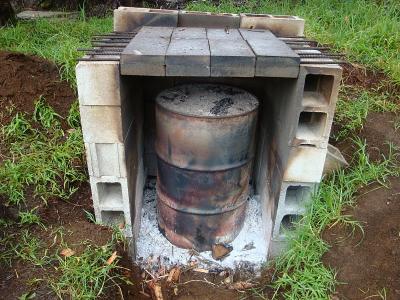
First is from the front of the kiln just after the fire was lit and before bricks were added across the front. The drum lid is held in place with an over-centre clamp. The side and rear bricks have been moved in to touch the drum to improve insulation.

Second is through a hole in the front brickwork, shortly after the gas started to flow. There are two fire layers – at the base of the fireplace, and an upper fire just under the drum. This is the gas exiting from the holes in the base of the drum, igniting, and then curling upwards.

From this weekend:

Assume that the drum is set up in the brick kiln
Equipment: chainsaw, axe and wheelbarrow
Old and dry fallen timber is available 30 metres from trial site.
Chainsaw and split 110 kg hardwood for drum load
Ditto 40kg for fuelwood
Load drum
Gather twigs and small dry branches, load fireplace with these and the 40kg wood
Seal drum and light fire.
Time = 45 minutes
Char output = 29kg.

Rough cost, including chainsaw fuel and some provision for wear and tear, and (say) $A20/hr for labour, then maybe $18 for 29kg char. If I could get $1/kg for char chunks for BBQ’s, and keep the fines for the soil, I’d be about square. Packaged charcoal (in briquettes with sawdust and other stuff added) retails in Oz for around $2/kg.

I still maintain and will get around to proving it some time, that if surplus gas could be withdrawn and stored, and then used for the fire, the 40kg of firewood would not be necessary. The level of the flames from the gas escaping through the poor drum seal demonstrates this, plus there are opportunities to improve on my rudimentary house brick insulation.

An observation is that smaller pieces of wood are more efficient. And the smaller the pieces the more mass that can be loaded into the drum. I’ve had successful chars with hardwood up to 20cm diameter, but I’ve also had some cases where the centres weren’t fully charred. A compromise is maximum thicknesses around 8-10cm.

I have to admit that I remain in awe of the whole process. Normally I start the fire around 17:00. It’s autumn here and dark and increasingly chilly by 18:00, which is around when the gas starts to flow. There’s a gentle whistle to start with, and within 15 or 20 minutes this becomes a muted roar, the flames creep around the gap between the drum and the bricks and filter through the bricks on top of the drum, the top bricks begin to glow red, and I sit (with glass in hand) and ponder on the vast amount of energy being released from 110kg of wood, and which lasts for several hours.

My latest garden trial includes basil, broad beans, corn, capsicum, egg plant and parsley in the trial plots. The beds were made on top of untilled soil, which is compacted and so hard that in another bed I had to use a mattock to break it up. The mix in the main bed includes mulch, cocopeat, some worm compost and char. This has now been established for 6 weeks, and not only is it easy to dig down to the base by hand, the first inch or so of soil under the bed is friable. The bed without the worm compost and char is also friable but the soil layer underneath is still rock-hard. The colour, vigour and size of the plants in the bed with char are substantially ahead of the control bed. Also, we’ve had no rain for 2 months and all plants are only watered once/week. There’s something going on here that I don’t fully understand, but I’m not complaining.

Max H

Gardening with Biochar FAQ (Wiki)

Last updated June 02, 2008

Gardening with Biochar FAQ (Wiki)
Philip Small, May 21, 2008

Welcome to a Gardening with Biochar FAQ!
... a work in progress...

When gardeners add biochar to garden soil, we are, in effect attempting to follow in the footsteps of the originators of Terra Preta. Because we don't know exactly how that process worked, nor how we can best adapt it outside its area of origin, we are left to discover much of this by experimenting with our own gardens and comparing observations within our own communities.

See:

Gardening with Biochar FAQ (Wiki)

Miscanthus and Willow Charcoal Trials

Last updated November 06, 2008
Robert Flanagan, May 22, 2008
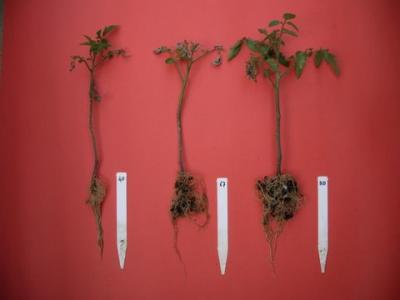
Attached are some photos of my latest trial with char (biochar/agrichar ). I achieved the above results with charcoal made
from willow and miscanthus at over 550C.
In the attached photos I just added the
char to local soil with no other additions.

1g Charcoal per seed

50g Miscanthus Charcoal per pot

50g Willow Charcoal per pot

Charcoal is only one part of terra preta farming as balance in the key and nutrient and carbon cycling. Pyrolysis only produces combustible gas when all the moisture has been driven off so it's not correct to say you get syngas from low temp pyrolysis unless you pre-dry your feedstock and then clean up the tars before going into a genset and making electric power.
Syndicate content