How To

Instructions for making or using black carbon in soils.

Don't Barbecue - Char-BQ!

Last updated August 10, 2010
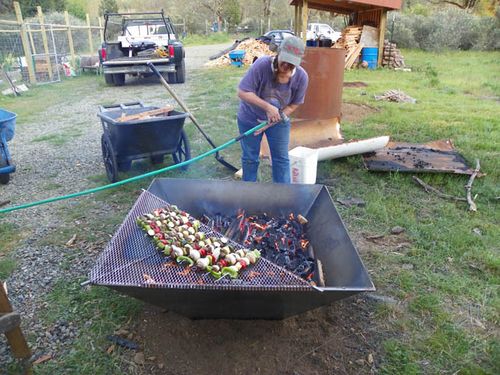
Cans burning: The cooking grate is now in place, with the iCans safely between the two grates.

Jock Gill, Summer 2010!!

See the attached pdf file for printable Char-B-Que Instructions in Gorgeous Full Color Detail!

Basic Elements -- these are the elements required to convert a Weber unit to a carbon
negative Char-B-Que.
The B stands for Biochar. Total cost: $0.00
two cans -- these will be turned into iCan TLUD stove units
For more pictures of other experiments: http://www.flickr.com/photos/jockgill/

Hint: Measure the circumference of the can. Divide that by the number of holes you
want to have in your design. Use that result as the distance between hole centers.
Mark the hole centers as per the above and then make your holes.

Hint: Always make small pilot hole first and then work your way up to bigger and bigger
holes made with larger and larger tools. A set of graduated nails and spikes works
great. When in doubt, start with fewer and smaller holes. In general, primary air holes
will be smaller and secondary air holes will be much larger. The number of holes you
use and their sizes, and locations, has to be tuned for draft conditions, fuel type, fuel
form factor, and fuel size.

Perfect Char-B-Que Chicken. Juicy. Tender. No smokey taste. And no burned bits at all.Skin was also very crispy.
Cooking time: about 45 minutes. The right iCan had more primary air holes, 21, and burned out at 40 minutes.
The left iCan was complete at 48 minutes. It had only 15 holes for primary air. Tuning is important.

Biochar from the wood pellets in the iCan TLUDs at the end of the Char-B-Que. The biochar, which will be mixed with compost and then added to gardens as a soil amendment is how carbon that was in the wood pellets is sequestered. The long term sequestering of the carbon from the biomass is what makes the Char-B-Que "Carbon Negative".

Incorporating Biochar in Your Garden, Grow More Closer to Home

Last updated August 17, 2010

Hugh McLaughlin, July 2010

This is a nice series on growing your food "close to home" which also features Hugh Mclaughlin giving a nice presentation about making biochar and incorporating it into your garden.

Grow More Closer to Home, produced by Barry Hollister

Introduction:

Making a "Better Burn Barrel" a straightforward Biochar Kiln

Incorporating the Biochar into your garden

Rockin Rocket Retort

Last updated May 26, 2010

Rob Lerner, May, 2010

From Rob's Biochar Blog: http://biocharlog.blogspot.com/
Also take a look at his Captioned Slideshow: http://picasaweb.google.com/bajarob/RockinRocketRetort#.

Using Biochar in Soil

Last updated May 18, 2010

David Yarrow, May 2010

Using Biochar in Soil

Preparation & Application

Biochar’s ultimate purpose and destination is soil, and improves almost any soil, especially with low rainfall or nutrient deficits. Adding char to soil makes this strategy carbon-negative, effective to reduce greenhouse gases and thus mitigate global warming.

Biochar improves soil by three critical services:

  1. Sponge to soak up water, hold and slowly it release to soil
  2. Storehouse to adsorp nutrient ions for exchange to biology
  3. Substrate to provide habitat & refuge for soil microbes

However, fresh, raw char in soil can retard plant growth for one or two years. For optimal response with minimal application char requires processing to prepare it for use in soil.

In North America, biochar is a new soil additive, so procedures to add it are under-developed and experimental. This document details guidelines and instructions to prepare and use biochar in soil, with a database to evaluate results and improve practices.

Read More http://terrapreta.bioenergylists.org/content/using-biochar-soil
or download as a pdf http://terrapreta.bioenergylists.org/files/UsingBiochar.pdf

Biochar Education: Cops, Cookies and Biochar

Last updated June 08, 2010

Tom Miles, Kelpie Wilson

The kids are so enthusiastic about doing these projects. They love the hands on aspects and the team work in problem solving. Their teacher, Darlyn Wendlandt does a wonderful job of involving them. Darlyn and I will be writing this up for Green Teacher magazine. I will also be presenting this work at the upcoming USBI conference and hopefully at the IBI conference in Brazil in September.

The report will also cover a biochar education project I am doing at an elementary school. One part of this project is making a tin can TLUD that I designed to be made using only simple hand tools. Inspired by designs from Hugh McLaughlin and Christa Roth. You can find a 6 page illustrated guide to making the stove at my website www.greenyourhead.com. This is where I post all my biochar project reports. Here's the link to the stove instructions:

http://www.greenyourhead.com/2010/04/the-dome-school-stove.html

Characterizing Biochars prior to Addition to Soils

Last updated January 16, 2010

Hugh McLaughlin, PhD, PE, Alterna Biocarbon Inc. , January 2010

Biochar is a vague term that applies to a potentially broad class of charcoal materials intended for addition to soils. Many raw materials and conversion processes can lay claim to producing biochar, and the resulting biochars will have different characteristics. The purpose of this discussion is to formulate a simple scheme for characterizing biochars before addition to soils. Efforts will be made to discuss the logic behind the individual characteristics, in addition to the limitations of the individual assays.

The presentation and content here is consistent with the paper titled “All Biochars are Not Created Equal, and How to Tell Them Apart”, by McLaughlin, Anderson, Shields and Reed presented at the North America Biochar Conference in Boulder, August, 2009. (http://cees.colorado.edu/biochar_characterization.html). However, this discussion is new, in the sense that it attempts to simplify the logic and methodology in order to arrive at a characterization strategy that is widely accessible to many practitioners.

The general characterization scheme breaks the biochar into a small number of constituent parts, consisting of: Moisture, Ash, Mobile Matter and Resident Matter. Each constituent part can be further subdivided, as will be discussed. Initially, we will discuss the significance of each portion, how it is measured and what the measurement represents. Then we will discuss additional biochar consideration when added to soils.

For addition detail, download the attached pdf: Characterizing Biochars

1G Toucan TLUD for Biochar Jan 2010

Last updated February 14, 2010

by Hugh McLaughlin, PhD, PE, Alterna Biocarbon Inc., January 2010 Version

Download the Instructions: 1G Toucan TLUD for Biochar Jan 2010 - final.pdf (630kb)

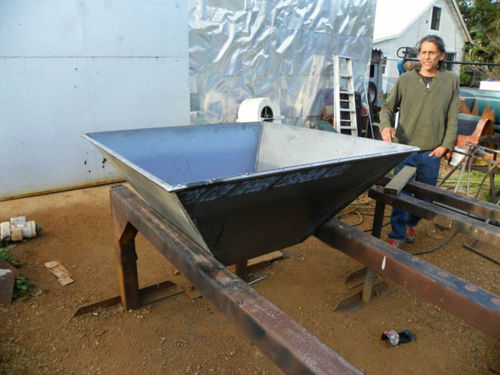
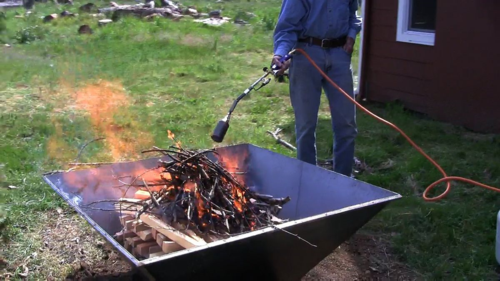
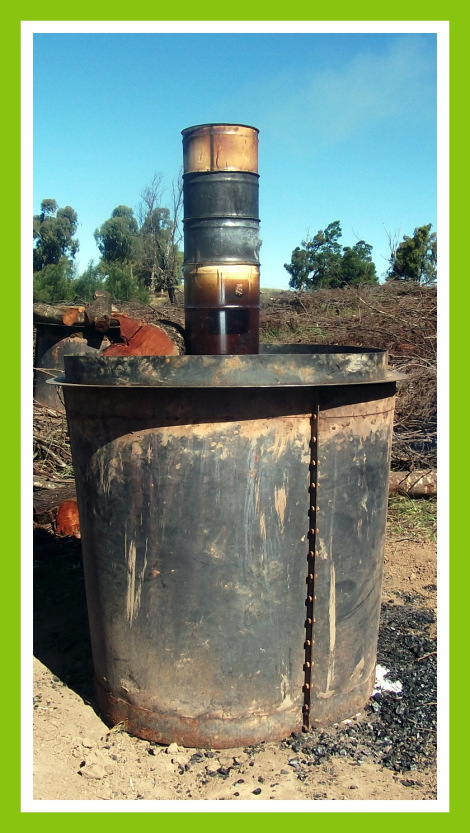
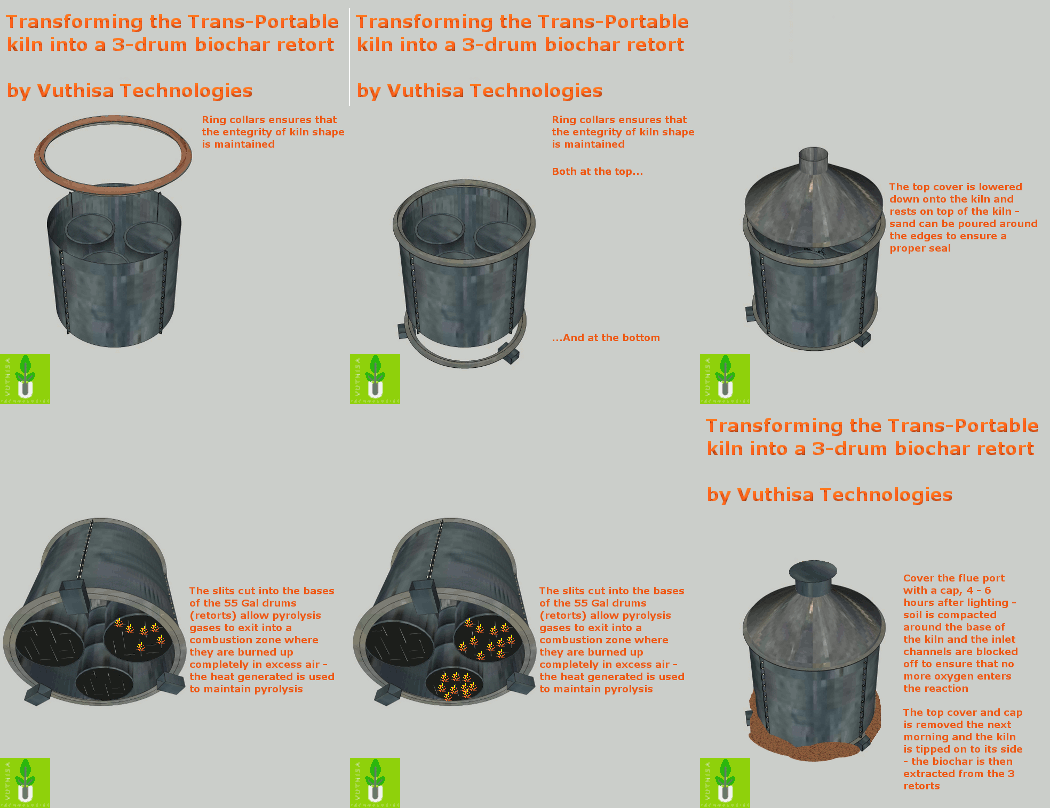
Make charcoal in your own backyard

Last updated December 08, 2009

Vuthisa, November, 2009

They have kindly put together a great How to Make charcoal in your own backyard …with a Portable Charcoal Kiln.. Take a look at their site for pictures, detail and corrections.

Two Barrel TLUD Construction

Last updated December 03, 2009

R. Diermair November, 2009

Attached as a Power Point file and a PDF is a nicely illustrated guide to creating a TLUD (top lit up-draft) biochar retort with two barrels. As he notes, understanding the TLUD is critical to getting reliable, clean take a look at our other TLUD References for more guidance.

BioChar School Stove from Tin Cans

Last updated January 05, 2010
school stove Img228

Sean Barry, November 2009

Look what I just made! I used a 46 oz juice can , a 14 oz kernel corn can, a can opener, a strip of tin, and some tin snips.

I will see if it can boil water now and makes charcoal out of wood chips. Then maybe I can send a you tube link. This is my first mock up of of the educational tool about biochar that I was thinking of developing and telling you about in Washington this past September. When it makes char, it should be smokeless, especially with dry feedstock, easy and cheap to build out of normal household stuff. and simple to use.

With a little tiny bit of charcoal (maybe close to a cup?) it could be put into two of four milk carton bottom test pots, then fertilizer in one with char and one without char. They kids could plant something grows fast and maybe edible (beans sprouts?), then measure the performance of their own soil with a real experiment (1/4 control, 1/4 just fertilizer, 1/4 both charcoal and fertilizer, 1/4 just charcoal. (just like my garden).

It could be an experiment started this winter after the holidays and ending late this spring before school let's out.

This little lab kit has four important elements -

1) Simple to make and use.
2) Makes charcoal.
3) Uses the energy that comes from making char to cleanly provide cooking heat.
4) Uses the charcoal as a biochar amendment into soil and has a real plant growth experiment.

Its a full cycle that will let kids have a simple starting point for understanding and then they can be creative and expand from there. I would suggest targeting it to the youngest kids possible and repeating it more than once in their curriculum.

Regards,

SKB

Syndicate content