Soil Acidity and Liming

Last updated December 18, 2008

Wood Ash: An Alternative Liming Material for Agricultural Soils

Last updated December 18, 2008

Wood Ash: An Alternative Liming Material for Agricultural Soils
Alberta Agriculture and Rural Development

Many forestry facilities in Alberta use bark, sawdust and yard waste, commonly referred to as "hog fuel," to generate steam, electricity and heat for plant operations. There are also several facilities that use hog fuel as an energy source to generate electricity. More than 180,000 tonnes of energy system wood ash produced annually at pulp mills, sawmills, oriented strand board and fibre board plants is currently disposed of in industrial or regional landfills.

See: http://www1.agric.gov.ab.ca/$Department/deptdocs.nsf/all/agdex3435

NEWMOA FACT SHEET Beneficial Use of Wood Ash on Agricultural Land

Last updated December 18, 2008

NEWMOA FACT SHEET: Beneficial Use of Wood Ash on Agricultural Land
April 6, 2001, Northeast Waste Management Officals Association

This fact sheet is intended to provide general information to potential users of unadulterated1 wood
combustion ash as an agricultural amendment. It is the responsibility of the producer and user of the ash to determine the appropriateness of a particular application and to select applicable tests and
specifications to facilitate its use and environmental protection. Potential users of unadulterated wood
combustion ash on agricultural land should contact the appropriate state regulatory program to identify specific use conditions and permit requirements. A listing of state contacts is located at the end of this fact sheet.

See: http://www.newmoa.org/solidwaste/FSWoodAsh.pdf

Best Management Practices for Wood Ash as a Soil Amendment

Last updated December 18, 2008

Best Management Practices for Wood Ash as a Soil Amendment
Prepared by Mark Risse, Extension Engineer, Updated by Julia Gaskin, Land Application Specialist 2002, Cooperative Extension Service,The University of Georgia College of Agricultural and Environmental Sciences

Wood was burned in the United States in the 1700s through the early 1900s to produce ash for chemical extraction. The ash was used mainly to produce potash for fertilizer and alkali for industry. As other potash production technologies became more economical, the value of wood ash as a raw material dropped.

Recently, ash has been considered a waste product instead of a resource, because few industries have taken advantage of its beneficial properties. Approximately 3 million tons of wood ash are produced annually in the United States. While approximately 80 percent of all ash is land applied in the Northeast United States, less than 10 percent is land applied in the Southeast. The other 90 percent in the Southeast is landfilled. Several alternative uses for wood ash have been developed. Land application is one of the best because nutrients taken from the land during harvest are recycled back to the land. In a survey of more than 80 Southeastern paper mills, 60 percent of the respondents reported interest in land application of wood ash. Figure 1 shows the distribution of wood ash in Georgia. It is apparent that wood ash has potential to be used as a lime substitute throughout Georgia.

See Factsheet and attaches

Team from Rice wins $10,000 in 'Recycle Ike' contest

Last updated December 11, 2008

Team from Rice wins $10,000 in 'Recycle Ike' contest
By Carolyn Feibel, Houston Chronicle, Dec. 10, 2008

A team of Rice scientists and students won a city contest Wednesday to devise a new way to recycle tree debris — by turning it into carbon-sequestering "biomass charcoal."

"This just goes to show how Houstonians have figured out in so many ways big and small how to make the best out of a natural disaster," Mayor Bill White said. "From necessity comes ingenuity and creativity, and I think that's what we're seeing here."

The winners of Houston's "Recycle Ike" contest accepted $10,000 in prize money, which they will use to build a pilot bioreactor on campus. The team of seven included students, graduate students, researchers and professors.

See article:
http://www.chron.com/disp/story.mpl/hurricane/ike/6158073.html

See winning proposal attached.

Pro-Natura Newsletter about Green charcoal and Biochar/Agrichar

Last updated December 07, 2008

Pro-Natura Newsletter about Green charcoal and Biochar/Agrichar
Guy F. Reinaud, ProNatura, December 2008

ProNaturaProNatura

Hello,

You will find attached the Pro-Natura International Newsletter about Green charcoal used either as renewable household energy or in the agronomic field as Biochar/Agrichar, increasing substantially and ecologically soil fertility.

We will be happy to provide any further information you might need.

All the very best.

Guy F. Reinaud
President
Pro-Natura International
15 Avenue de Ségur
75007 Paris

Tel. +33 680 61 09 36 mobile
www.pronatura.org

2009 Events Calendar Carbon-Negative Northeast Network and Biochar FAQ

Last updated November 28, 2008

2009 Events Calendar Carbon-Negative Northeast Network
http://tech.groups.yahoo.com/group/carbon-negative
Communities Confronting Climate Change, Energy Independence and Food Security
David Yarrow,November 2008

Carbon NegativeCarbon Negative

2009 Events Calendar
final version. see attached .pdf file
one page

i am assembling information into two FAQ sheets, one on biochar, the other on carbon-negative.

Attached is my first draft of the biochar FAQ.

for a green & peaceful planet,

David Yarrow
Turtle EyeLand Sanctuary
44 Gilligan Rd, East Greenbush, NY 12061
cell: 518-881-6632
www.championtrees.org
www.OnondagaLakePeaceFestival.org
http://tech.groups.yahoo.com/group/carbon-negative
www.farmandfood.org
www.SeaAgri.com

Agricultural bio-char production, renewable energy generation and farm carbon sequestration in Western Australia

Last updated November 28, 2008

Agricultural bio-char production, renewable energy generation and farm carbon sequestration in Western Australia: Certainty, uncertainty and risk
Mark P. McHenry, Murdock University, Western Australia, January 2009
Agriculture, Ecosystems and Environment, www.elsevier.com/locate/agee
http://dx.doi.org/10.1016/j.agee.2008.08.006

Abstract
Reducing the vulnerability of agriculture to climate change while increasing primary productivity requires mitigation and adaptation activities to generate profitable co-benefits to farms. The conversion of woody-wastes by pyrolysis to produce bio-char (biologically derived charcoal) is one potential option that can enhance natural rates of carbon sequestration in soils, reduce farm waste, and substitute renewable energy sources for fossil-derived fuel inputs. Bio-char has the potential to increase conventional agricultural productivity and enhance the ability of farmers to participate in carbon markets beyond traditional approach by directly applying carbon into soil. This paper provides an overview of the pyrolysis process and products and quantifies the amount of renewable energy generation and net carbon sequestration possible when using farm bio-waste to produce bio-char as a primary product. While this research provides approximate bio-char and energy production yields, costs, uses and risks, there is a need for additional research on the value of bio-char in conventional crop yields and adaptation and mitigation options.
Keywords: Bio-char; Charcoal; Soil; Carbon; Renewable; Biomass; Western Australia

Received 22 June 2008; revised 31 July 2008; accepted 5 August 2008. Available online 25 September 2008.

Article Outline
1. Introduction
2. Bio-char production and feedstock
3. Bio-char and agricultural suitability
4. Bio-char and alternative biomass products and services
5. Bio-char production and greenhouse gas emissions
6. Conclusion
References

World premiere of a pyrolysis plant combined with a Stirling engine
Last updated February 07, 2009
in

World premiere of a pyrolysis plant combined with a Stirling engine
Danish Stirling, October 24, 2008
AarstiderneAarstiderne
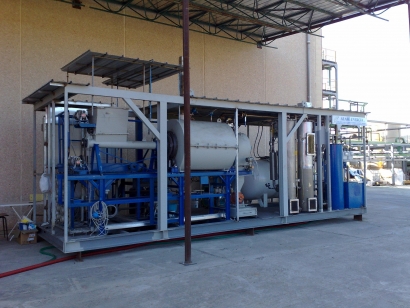
On October 24th the Danish Minister for the Environment Troels Lund Poulsen officially inaugurated the new pyrolysis plant at Barritskov Gods supplied by Stirling Denmark. The plant is the worlds first pyrolysis plant based on a Stirling engine and will provide heat and power to the facilities. Furthermore, the plant will produce a valuable charcoal for soil improvement and CO2 sequestration. The plant has been designed by Stirling Denmark based on the SD4 engine and on research on pyrolysis at DTU, Denmark. The plant will initially run on wood chips from recycled wooden crates, but the plant is expected to be able to handle many different types of biomass.

See more at Aarstiderne and also (video) http://www.dr.dk/odp/player.aspx?uniqueid=309067&mt=newstab&st=news_TVAv...

(both in Danish)

Aarstinderne as translated to English using Google.

http://www.stirling.dk/

A charcoal production plant that also generates heat and electricity from the by-product gas

Last updated February 24, 2009

A charcoal production plant that also generates heat and electricity from the by-product gas
Biofuel Energy Sustems, Sustainable Energy Ltd., UK, 2004
BES Carbonizer

In 2004 Biofuel Energy Systems Ltd. developed a plant for charcoal production, which uses the gases given off during production to drive a gas turbine, generating heat and electricity. The electricity generated can be used on site (especially useful in remote areas with no electrical grid connection) or sold back to the grid for additional profit.

Conventional charcoal production is very inefficient and wastes half of the energy within the wood. Biofuel Energy Systems' unique plant, however, uses 90% of the wood's energy and uses a totally clean, emission-free process. See the diagram on the Biofuel Energy Systems website that shows the steps involved in simplified terms. This represents a huge advancement in the efficiency and cleanliness of charcoal production.

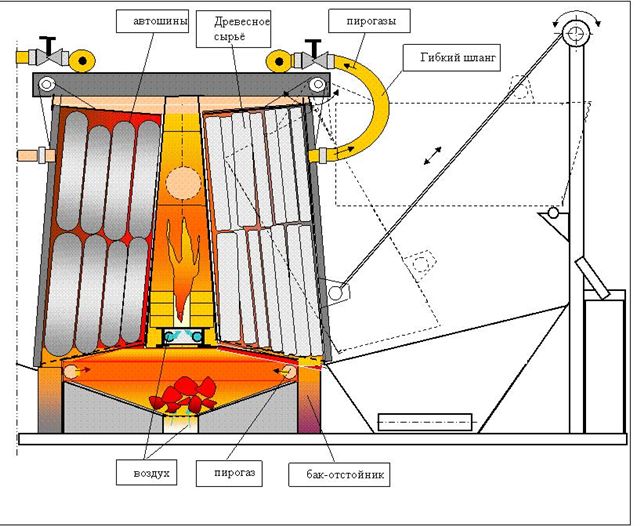
The gasifier can supply the sensible heat for initiating pyrolysis. This is done by gasifying waste vegetable oil (low ash to interfere down stream) and using the high pressure exhaust from this to recirculate hot gas through wood. The gasifier products and pyrolysis offgas are then fed to the combustion chamber of a small (40kW) gas turbine.

Schematic
Click on the picture for a larger image.

The plant is suitable for both large and small-scale charcoal production as the design can be scaled up or down according to requirements. The amount of charcoal production could range from 200 to 4,000 tonnes per annum and the electrical output of the plant could range from 50kW to 1MW, depending on the size of the plant.

To find out more see the Biofuel Energy Systems website. http://www.biofuelenergysystems.co.uk/index.htm

Syndicate content