Carbon Pollution Reduction Scheme

Last updated October 14, 2008

<

p>Carbon Pollution Reduction Scheme
Jerome Mathews, Australian Biochars www.Biochars.com September 28, 2008
Submission by Australian Biochars Pty Ltd

At the Government seminar to introduce the Government’s Green Paper on the Carbon Pollution Reduction Scheme (CPRS) held in Brisbane on the 18th July, 2008 Australian Biochars was invited to present a submission as to whether, in its opinion, it would be a viable option to include the use of biochar in some way in the CPRS.

<

p>

For the reasons set out below, it is submitted that such a use would be both viable and effective because:
• Biochar sequesters and stores greenhouse gasses for far longer than forests are able so to do;
• Biochar does not require tending, watering or fertilising, unlike forests;
• Biochar is not subject to the vagaries of disease, fire or weather, unlike forests;
• Biochar increases crop yields;
• Biochar use makes for easy accounting;
• Biochar use is open to participation from multinational corporationsdown to individual users;
• Biochar has high water retention properties and is beneficial in drought conditions.

Carbonized Rice Hull

Last updated November 06, 2008

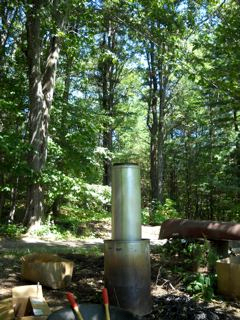
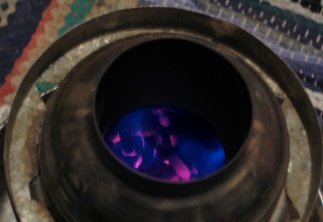
Carbonized Rice Hull
Courtesy www.Biochars.com, September 28,2008

Philippine Rice Research Institute (PhilRice)Rice Technology Bulletin, No. 47, 2005

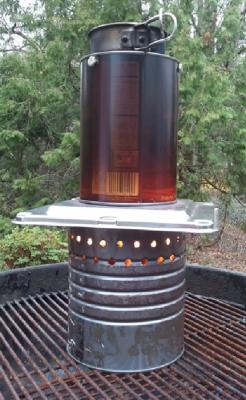
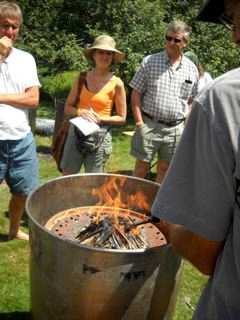
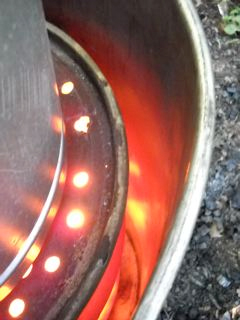
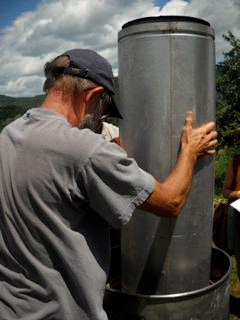
PhilRice Open Type
PhilRice Open Type


<

p>

Nutrient Recovery from Integrated Cellulosic Biorefineries

Last updated September 22, 2008

Nutrient Recovery from Integrated Cellulosic Biorefineries (link)
Robert Brown, Iowa State University, Bioeconomy Institute 2008

"That Iowa has some of the richest soil in the world is no secret, and a group of researchers at Iowa State University would like to ensure that Iowa’s soil retains its high quality. These researchers are investigating alternative cropping systems and practices such as applying biochar (also called agrichar) to the soil to protect it from the loss of organic matter and fertility that could accompany the proliferation of biorefineries across Iowa’s landscape. The Iowa State research team is looking at the impact of the removal of large amounts of crop residue from agricultural fields. Their goal is to ensure that farmers will be able to generate the large amounts of biomass feedstocks that cellulosic biorefineries will need to meet the
demands of a developing bioeconomy, while also being able to return carbon
and important nutrients such as phosphorus, potassium and nitrogen back to the soil."

See Links

Peter Cundall: Slow Burning Solution

Last updated March 10, 2009

Peter Cundall: Slow Burning Solution
In Organic Gardener (Australia), September/October 2008, Courtesy Ron Larson and Albert Bates
Using Biochar
Using Biochar


Excerpt:
"How can we use biochar?

That’s where we come in. I’m just one of many gardeners throughout the world beginning to experiment and study the way charcoal, mixed with added minerals – such as forms of decomposed organic matter and other natural nutrients – can be used in suburban food gardens.

Already I have managed to achieve surprising results. For a start, it has become clear that less water and fewer fertilisers are needed in soils enriched with biochar. Acidic soils benefit by being sweetened, earthworm populations increase and bacteria land other forms of life in the soil become more complex and balanced. There is some evidence that methane gas emissions from the soil are also reduced, as well as those of nitrous oxide, a deadly greenhouse gas that is 310 times more destructive to the atmosphere than carbon dioxide.

In our Tasmanian garden, this soil treatment has already produced better, healthier growth and plants that appear to be resistant to diseases and suffer fewer pest attacks.

First, an obvious question: where can gardeners get biochar? How can home gardeners make it, without causing atmospheric pollution? Already a few (though not many) garden centres are selling pulverised charcoal – mainly for orchid growers. It can be expensive, but I believe that in the near future an increased demand for biochar will make it an easily available, cheap soil additive.

How Can we Produce It?

Charcoal can be made from any form of so-called waste organic matter. Our rubbish tips are full of the stuff. Major sources include countless millions of tonnes of factory and farm waste such as animal droppings, sugarcane trash and straw. Forestry and sawmill operations produce great piles of organic debris, much of which is
burnt on site, causing serious pollution and health problems. Deliberately-lit forest burns are a still a major source of greenhouse gas emissions.

Modern techniques of creating huge amounts of biochar by heating organic matter in an almost oxygen-free environment (without pollution) have now been developed and are already in use in many countries. Combustible gases produced during these processes
are carefully drawn off and stored or put to use. Clearly, environmentally-sensible
methods of manufacturing biochar are both possible and beneficial.

Living in a cool climate has helped me make my own charcoal. We use a slow-combustion wood-fired heater and cooker. This flat-top stove is big, black, ugly and built like a Centurion tank. When I bought it 25 years ago, it had a label attached which claimed that it was ‘Guaranteed for Life’.

We can insert two giant logs in it and, by virtually cutting off the air supply, cause the wood to burn slowly while still throwing out heat for the best part of a day. A double-burner ensures no combustible gases escape,and there is hardly any smoke.

It enables us to heat our home and, at the same time, slow-cook casseroles, soups and other food. After about 12 hours, even very large logs have gradually been turned into huge chunks of brittle charcoal that can be easily and safely raked out.

Making biochar mix

After being cooled by being dumped on clumps of perennial weeds and then wetted, the charcoal lumps are ready for crushing. I add wet coco-peat to keep the moisture in and help absorb dust particles. Some gardeners recommend crushing charcoal chunks by placing them in a strong bucket and bashing them. Unfortunately, most buckets
aren’t made to take this type of battering and will quickly fall apart.

An easier, more reliable, method is to use two hefty firewood logs, one of them with a fairly flat surface. Here’s how to do it:
• Spread a plastic sheet over an area of level ground with the flat piece of wood laid on top, near the centre.
• Thickly spread the charcoal pieces over the flat top of the wood and give them
a good thumping using the butt of the second log. It takes only minutes to make half-a-bucket of crushed charcoal.
• Into this, mix one-part each of coarse sand and garden (or potting) soil to double the bulk. Where leafy or other nitrogen-hungry vegetables are to be grown, I also add 2 litres of water into which one tablespoonful of fish emulsion and another of seaweed concentrate is dissolved.
• When this is poured into the charcoal mix, a stiff black slurry, thickly dotted
with fragments of charcoal is created. It can be stored or used straight away.

Other uses

Biochar can also be used as a surface mulch, where the black colour helps the soil to warm more rapidly in early spring. It can also be applied as a side dressing alongside growing plants. I prefer to bury it prior to sowing seed or planting seedlings. If used to grow potatoes, place the seed tubers along the base of a 20cm-deep trench and cover with a thin layer of soil. Then spread a 5cm-deep and wide layer of biochar over the top and back fill with soil.

Does it work?

The most dramatic results I’ve had so far are with sweet corn. I created two
15cm-deep grooves in the soil, then half-filled them with biochar mix and covered this with soil. I sowed the sweet corn seeds just beneath the surface, but in contact with the layer of biochar. I also sowed two other rows of sweet corn seed, this time without biochar, using only pulverised sheep and poultry manure mixed with blood and bone.

Two weeks later the differences were already obvious. The biochar seedlings were up and moving fast, while the rows of untreated seeds showed erratic germination. As the plants grew, I watered all of them and later mulched them in the same way. However, the biochar corn grew with extraordinary strength and final yields were at least
twice that of the untreated rows. Some biochar-treated plants actually bore up
to six large cobs each, because even the side-shoots (normally non-productive)
both carried two cobs each.

A similar biochar experiment with tomato seedlings showed little difference in yield, although treated plants had a slightly healthier leaf colour and showed no signs of disease."

See article attached.

Organic Gardener, New South Wales. http://www.abc.net.au/gardening/features/organic_gardener.htm

For more information about Peter Cundall see:
Peter Cundall (Wikipaedia)
Peter Cundall on Gardening Australia ABC Website

International Biochar Initiative Newletter

Last updated September 17, 2008

International Biochar Initiative Newletter
August 2008

The International Biochar Initiative (IBI) began issuing a monthly newsletter in August 2008. To subscribe to the newsletter go to:

http://www.biochar-international.org/images/August_2008.pdf

Sustainable Forest Bioenergy Production Using In-woods Fast-pyrolysis Conversion Including Bio-oil Production and Bio-char

Last updated August 26, 2008

Sustainable Forest Bioenergy Production Using In-woods Fast-pyrolysis Conversion Including Bio-oil Production and Bio-char Incorporation
USDA Forest Service News East to West 08/11/2008

Rocky Mountain Research Station
Researchers Receive Biomass Grant
RMRS Research Soil Scientist Deborah Page-Dumroese, Moscow, and her collaborators were recently awarded a biomass grant from the Washington Office. She is working with the University of Idaho, University of Montana, Umpqua National Forest, and Renewable Oil International, LLC on a project titled "Sustainable Forest Bioenergy Production Using In-woods Fast-pyrolysis Conversion Including Bio-oil Production and Bio-char Incorporation.” This study will evaluate the economics of converting logging slash into bio-oil and bio-char. The bio-char can then be applied back on the soil as an amendment. Bio-oil can be burned as a direct substitute for fuel oil, or further refined into liquid transportation fuel. Bio-char is equivalent to charcoal produced from forest fires.

See also:
Debbie Page-Dumroese
Project Leader, Root Disease and Soil Biology
Rocky Mountain Research Station
1221 South Main Street
Moscow, Idaho 83843
(208) 883-2339

Fire and Fire-Suppression Impacts on Forest-Soil Carbon

Production and use of a soil amendment made by the combined production of hydrogen, sequestered carbon and utilizing off gases

Last updated August 22, 2008

Production and use of a soil amendment made by the combined production of hydrogen, sequestered carbon and utilizing off gases containing carbon dioxide
United States Patent 20040111968
Day, Danny Marshal (Atlanta, GA, US)
Lee, James Weifu (Knoxville, TN, US)
06/17/2004

FIELD OF THE INVENTION

[0002] This invention relates to the production and use of a nitrogen enriched carbon based fertilizer and soil amendment made during the pyrolytic conversion of carbonaceous materials which produce charcoal and the reaction of said charcoal with ammonia, carbon dioxide, water and other components generally found in flue gas emissions. The invention also relates to the optimization of that charcoal with mineral and plant nutrients to produce and use the combined materials as a soil amendment and fertilizer. The invention also relates to the use of the material as a way to economically store carbon and captured greenhouse gases in the soil.

Evaluating Performance of Ecologically Sound Organic Substrates under Different Temperature Regimes

Last updated August 21, 2008

Evaluating Performance of Ecologically Sound Organic Substrates under Different Temperature Regimes
SHAHIDUL ISLAM, U Arkansas, INTERNATIONAL JOURNAL OF AGRICULTURE & BIOLOGY, 2008

ABSTRACT
Greenhouse trials were carried out over two years to investigate the high temperature (25ºC, 30ºC & 35ºC) effects on ecologically sound untreated organic substrates viz., coconut coir and rice husk charcoal, in comparison to that of rock wool using tomato (Lycopersicon esculentum Miller) as a test crop. There were no significant differences in the root dry matter, stem dry matter, fruit dry matter, shoot and root ratio, ascorbic acid, total soluble solid, fruit acidity, leaf chlorophyll contents and pH of the fruit homogenate. Among the substrates, water holding capacity was larger in rock wool followed by coconut coir and rice husk charcoal. Bulk density and total pore space were lower in rice husk charcoal than coconut coir and rock wool. Regarding the chemical properties, rice husk charcoal and coconut coir had higher EC values compared to rock wool. Rice husk charcoal had relatively higher pH followed by rock wool and coconut coir. In the case of CEC rook wool showed significantly higher values than coconut coir and rice husk charcoal. It also appeared that rice husk charcoal and coconut coir gave similar and/or better crop performance and yield of tomatoes than rock wool under high temperature stress conditions namely 30oC and 35ºC as compared with 25ºC. Thus, rice husk charcoal and coconut coir can be used successfully as growing media amendments for producing greenhouse tomato as well as other nursery crops.

Key Words: Organic substrates; Temperature; Stress; Tomato; Quality

Islam, S., 2008. Evaluating performance of ecologically sound organic substrates under different temperature regimes. Int. J. Agri. Biol.,10: 297-300

Biochar Trial 2 - Design [Draft]

Biochar Trial Photos
Empty Planting Trays on Rack Fine Wet Processed Charcoal Settling in Flask Bamboo Feedstock Softwood Chip Feedstock
Charcoal Production in Woodgas Stoves Charcoal Grades Char Measurement  
Amended Pots Prior to Mixing Pots Mixed and Seeds Sown Growth After 9 Days Wheat and Peas Seperated to Avoid Shading

Some design features below:
Exploring interaction effects of feedstock type, soil, char application
rate, crop species, char size, fertilization, and mycorrhizal fungi.
No repetition (n=1), this loses the ability to assign a statistical
significance level to results, but allows more interactions (96 unique
combinations, 96 pots) to be tried given limited resources.

Charcoal produced in WoodGas stoves.
Char yield 12-18% (char mass/air dry biomass mass) (ie not adjusted to conventional dry weight yield unit, yet).
Fine Char - Blended and sieved to 230 mesh (<63 micron).
Coarse Char - Blended and sieved to between ~24 mesh - 8 mesh.
Fertilizer - 4-4-4 NPK Organic (bone meal, feather meal...)
Potting Soil - Potting Mix
Sandy Soil - Mixture of Horticultural Sand and Sandy Loam from Central Valley

Pots arranged in random spatial order (to randomize light/watering variation). Trays rotated to limit effects of light/watering variation.
Automatic drip emitter watering. Pots grown in enclosed cage outdoors.

Blocks - ( 8 pots/block)
    Fertilizer {Yes,No}
    Plant {Wheat, Pea}
    Soil {Sandy, Potting}

Blocks - (12 blocks * 8 pots/block = 96 pots)
    B1 -    Char (0 g)
    B2 -    Char (1 g, Pine, Fine)
    B3 -    Char (1 g, Pine, Coarse)
    B4 -    Char (1 g, Bamboo, Fine)
    B5 -    Char (1 g, Bamboo, Coarse)
    B6 -    Char (5 g, Pine, Fine)
    B7 -    Char (5 g, Pine, Coarse)
    B8 -    Char (5 g, Bamboo, Fine)
    B9 -    Char (5 g, Bamboo, Coarse)
    B10 -   Char (0 g) + Mycorrhizae
    B11 -   Char (5 g, Pine, Coarse) + Mycorrhizae
    B12 -   Char (10 g, Pine, Coarse)
 

Syndicate content