Torrefaction

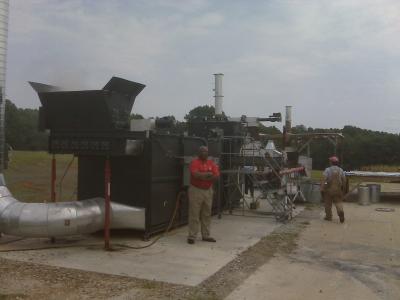
Torrefaction: Picture - Machine #2 - 8/14/08

Last updated November 06, 2008

Torrefaction: Picture - Machine #2 - 8/14/08
Joseph J. James, Agri-Tech Producers, LLC, August 15, 2008

Agri-tech Machine #2

Colleagues:

As most of you know, we are commercializing a unique form of torrefaction technology, developed by NC State University (NCSU). This process will densify, add value to, improve the characteristics of woody biomass, making it a much better feedstock for which to co-fire with coal, make superior pellets and briquettes and to use in gasifier operations. It also allows treated biomass to be shipped more economically and for greater distances.

Here's a picture of the 2nd-generation torrefaction machine. It is now operational and we are scheduling visits for a very limited number of additional individuals, on Friday, August 29th. Let me know if you wish to visit. Our horizon for having commercial units available is now sooner, rather than later, thanks to the hard work of our NCSU team and our strategic partners.

Regards,

JJJ

Joseph J. James
President
Agri-Tech Producers, LLC
116 Wildewood Club Court
Columbia, South Carolina 29223
Phone: (803) 462-0153
Cell: (803) 413-6801
Fax: (803) 462-9676
E-Mail:josephjjames@bellsouth.net

Using Torrefied Wood for Electricity and Pellet Production in South Carolina

Last updated August 21, 2008

Using Torrefied Wood for Electricity and Pellet Production in South Carolina
Chris Hopkins, NCSU, and Agritech Producers LLC, February 25, 2008

Presentation to the South Carolina Biomass Council
Description of mobile torrefaction program at NCSU.

Process for converting ligneous matter of vegetable origin by torrefaction, and product obtained thereby

Last updated March 11, 2008

Process for converting ligneous matter of vegetable origin by torrefaction, and product obtained thereby
United States Patent 4553978
Link to this page:
http://www.freepatentsonline.com/4553978.html

Abstract:
The present invention relates to a process for converting ligneous matter of vegetable origin by torrefaction, and to the product obtained. Wood or any other ligneous matter is subjected in a neutral atmosphere to a treatment of torrefaction at a temperature of between 200° and 280° C., and preferably between 240° and 260° C. for a duration of 30 mins. to 5 hours. The product of the invention is not fermentable, it has a specific mass close to 0.25 kg/dm3, a calorific power of at least about 5000 kcal/kg, a content of fixed carbon of 35 to 40% and can be broken up by hand; it may be used as fuel in boilers and in gas generators.
Inventors:

Yvan, Schwob (Paris, FR)

Application Number: 06/410636
Filing Date: 08/23/1982
Publication Date: 11/19/1985

Netherlands: Torrified Wood Links

Last updated March 08, 2008

Torrified Wood links
Tom Miles, March 8, 2008
ECN Torrified WoodECN Torrified Wood
Development of 2nd Generation Pellet fuels in the Netherlands: Torrified Pellets Pell@tlas, European Pellet Centre, Newsletter, January 2008.

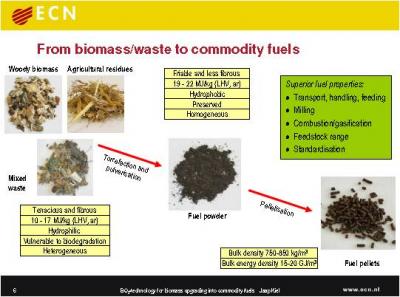
ECN B02-technology for Biomass Updgrading Jaap Kiel, Wageningen, 20 November 2007

ECN TOP (Torriefied Wood Pellet) Technology for the Production of Biomass Commodity Fuels. J. Kiel, Poland 2006

Torrefaction for Biomass Upgrading into Commodity fuels J Kiel, IEA Task 32 Berlin, May 2007.

PRE-TREATMENT TECHNOLOGIES,AND THEIR EFFECTS ON THE INTERNATIONAL BIOENERGY SUPPLY CHAIN LOGISTICS: Techno-economic evaluation of torrefaction, fast pyrolysis and pelletisation Ayla Uslu, Department of Science, Technology & Society Utrecht University, the Netherlands and Energy research Centre of the Netherlands (ECN).Biomass Department, Petten, the Netherlands, December 2005.

Torrefaction for entrained-flow gasification of biomass

Last updated March 05, 2008

Torrefaction for entrained-flow gasification of biomass
P.C.A. Bergman, A.R. Boersma, J.H.A. Kiel, M.J. Prins, K.J. Ptasinski, F.J.J.G. Janssen, ECN, Netherlands, ECN-C--05-067,
http://www.ecn.nl/docs/library/report/2005/c05067.pdf

Abstract
A major technical obstacle in entrained-flow gasification of biomass concerns the size reduction and the subsequent pneumatic transport of the biomass powder. The fibrous structure of fresh biomass makes it very difficult and costly to reduce its particle size down to below 500 microns.

Torrefaction, a thermal treatment of biomass in the temperature range of 200 °C to 300 °C in absence of oxygen, is capable of enhance the size reduction characteristics. Torrefaction partially destructs the fibrous structure of biomass and is therefore an interesting pre-treatment option for this application. However, the influence of the torrefaction process conditions and used biomass on the grindability and pneumatic transport properties of biomass is nowhere quantified, as well as the responsible decomposition mechanisms and its kinetics. This work quantifies these relations with the aim to produce design data for entrained-flow gasificationbased bioenergy conversion chains.

An experimental torrefaction programme has been conducted in multiple reactors on both
laboratory and bench scale, varying from 5 cc to 20 l batch wise capacity. In these facilities, intensive parametric testing has been carried out to provide insight in the thermochemical decomposition mechanisms during torrefaction. Subsequently, the produced torrefied biomass has been used to effectuate size reduction and fluidisation experiments to investigate its grindability and fluidisation behaviour. The size reduction experiments have been carried out with a cutting mill, while a cold-flow bubbling fluidised bed has been used to characterise the fluidisation behaviour of (torrefied) biomass.

This work reveals the influence of the torrefaction temperature and residence time, feed particle size, and type of biomass on the main characteristics of product quality, size reduction (power consumption and capacity of a grinding device), and fluidisation (Geldart classification as a function of particle properties). Furthermore, possible mechanisms responsible for the observed changes in grindability and fluidisation behaviour are proposed. Torrefaction leads to a very substantial improvement of the grindability and fluidisation behaviour. It therefore provides a solution to the problems concerned with entrained-flow gasification related to size reduction of
biomass and the subsequent pneumatic transport of the powder.

Conclusions
Torrefaction
In general, the conducted experiments reveal that torrefaction can be applied with a high biomass to solid energy yield ranging from 95-100% within the lower temperature region (<250°C) to 83-95% within the higher temperature region (250-270 °C). At a temperature exceeding 270 °C, the energy yield drops further, but can still be limited when the reaction time is kept short. The corresponding mass yields are consistently lower and range from 90-100% within the lower temperature region and 80% to 90% in the higher temperature range (up to 270 °C). From the analysis of the volatiles, it is concluded that the increased production of water and CO2 with increased temperature mainly explains the interrelation between both yields. The production of these non-combustibles leave the energy yield unaffected while the mass yield is decreased.

The observed order of reactivity of the examined biomass types is larch << willow/beech

Torrified Wood

Last updated March 10, 2008

Torrified Wood
James R. Arcate, Transnational Technology LLC, http://www.techtp.com, March 10,2008

Producers

Brazil:

The university of Campinas in Brazil and the company Bioware (www.bioware.com.br) are producing torrefied briquettes ina 200-300 kg/h pilot facility:

http://www.techtp.com/recent%20papers/wood%20briquette%20torrefaction.pdf

Contact :Felix Fonseca Felfi. fffelfli@hotmail.com

UK: http://www.airless-systems.co.uk/torrefying.shtml

Netherlands: Topell http://www.topell.nl

US:
NewEarth Renewable Energy Inc.http://www.newearth1.net/

Biocoal www.biocoal.net

Processing Equipment

UK: Air-less systems http://www.airless-systems.co.uk/torrefying.shtml

US
Wyssmont http://www.wyssmont.com/

Syndicate content