Below are recent reports from people actively designing, making and using biochar systems. It may help to refine the list by using the "Processes" navigation at the left.

We also have a simpler list in How To

Carbonization

  • Chris Adam Kiln Chars Coconut Shells in Kenya
    November 5, 2009

    Cocnut Husk in Kenya
    Coconut Husk in Kenya

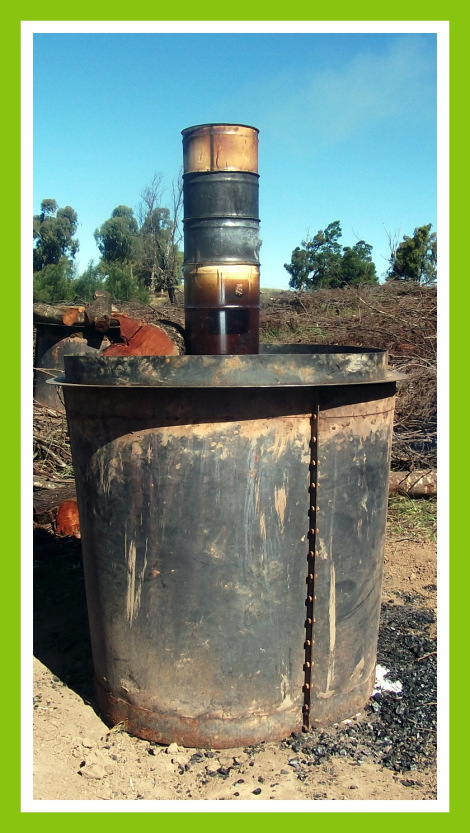
    A Chris Adam Kiln retort which was built a year ago at the Kenyan Coast.

    They are using it 3x a week to carbonize coconut shells and it seems to work well.

    --Chris

    5 Nov 2009 - 8:18pm
  • MAKING BIOCHAR: with Peter Hirst of New England Biochar

    Many thanks to George Packard of Parrot Creek Productions, Warner, New Hampshire for some really fine work. This is the short version of greater works in progress. Very well done by George and much appreciated.

    Peter Hirst

    9 Oct 2009 - 4:33pm
  • MAKING BIOCHAR: with Peter Hirst of New England Biochar

    Many thanks to George Packard of Parrot Creek Productions, Warner, New Hampshire for some really fine work. This is the short version of greater works in progress. Very well done by George and much appreciated.

    Peter Hirst

    9 Oct 2009 - 4:33pm
  • Al Latham, September, 2009

    I have a pdf (download the attached file) showing a simple biochar retort that I put together, that
    might be of interest to your viewers.

    If you'd like to add it to the Making BioChar.

    7 Sep 2009 - 9:00pm

Drum kiln

  • Gasifier Charcoal as a Substitute for Vermiculite in Container Growing Media
    Tom Miles, August 22, 2009
    P Pine Seedlings in 25% BiocharP Pine Seedlings in 25% Biochar
    Our second trial of biochar as a substitute for vermiculite in container media for growing tree seedling has proved successful. These tests are by a private nursery to determine if charcoal from a gasifier heating system can be used in container growing media.

    Last year weathered charcoal was collected from forest fire burns, milled, and used as a direct substitute for vermiculite in up to 50% of the container mix. Some of those trees have been retained in containers for a second year and still look good. At that time the forest tree nursery concluded that the biochar could be used for up to 50% of the mix with some adjustments to plant nutrition.
    http://terrapreta.bioenergylists.org/charcoalmedia

    This year the nursery filled a larger sample with media containing 25% biochar from a gasifier.

    During gasification the char is made as wood (mixed Pine and Douglas Fir from the California Coast range) is subjected to temperatures of 1000 C (1832 F) in an oxidizing atmosphere and 850C (1562 F) in a reducing environment. Tars are volatilized and combusted to carbon dioxide and water. Tars are completely consumed in the process. The CO2 reacts with the devolatilized charcoal to form a gas rich in carbon monoxide and hydrogen. The gas will be used in place of propane to heat greenhouses.

    Water is condensed from the gas. The recovered water (condensate) could probably be used to supplement irrigation. It is clear to light lemon colored and has a faint odor. It has a pH of 7.1 and is highly saline with an electrical conductivity (EC) of 5.1 mS/cm. It will be analyzed for composition.

    Less than 5% of the dry fuel is recovered from the gasifier as a charcoal residue. The charcoal residue is still being characterized. It is small in size and puffy with powdery fines that are like a confectioner’s sugar. Due to the conditions of carbonization it is likely that it has very low labile (volatile) carbon, high surface area, high CEC and high pH. (High pH does not appear to have affected nutrient availability in previous trials even up to 50% charcoal in the container mix.) It was tested at the nursery as biochar.

    Ponderosa pine seedlings grown in 25% gasifier charcoal since June were identical in root development and plant growth as those grown in the vermiculite mix. Two of each are shown in the attached image.

    Future trials will use biochar in media to grow other tree species.
    Condensate from Wood GasCondensate from Wood Gas

    22 Aug 2009 - 1:26pm
  • Peter Hirst, Pony Farm in Temple, New Hampshire, on May 9, 2009.

    Follow the link for some great video from the recent Biochar Roundtable at the Lodge at Pony Farm in Temple, New Hampshire, on May 9, 2009.

    Pony Farm Biochar Workshop
    Pony Farm Biochar Workshop

    http://thinkingglobalactinglocal.com/biochar-workshop-may-9-2009.html

    23 Jun 2009 - 10:48am

Making Charcoal

Gasification

Top-lit updraft kiln (TLUD)

Pyrolysis

  • Energy Cost of Charcoal
    Bryce Nordgren, (Rev) March 26, 2009

    Because I really had no idea about how much energy it takes to make
    charcoal, I made a table from the specs of the Chinese equipment posted by
    gordon eliot. Then I calculated the "Energy Cost" of each component in
    (MJ/kg). Finally I aggregated the energy costs from the "suggested
    charcoal plants" to get an idea of the energy cost of the entire system.
    Note that all of their plants use the new high efficiency coal bar
    machine. This should represent a best case scenario: maximum rated
    charcoal production at rated power. If you make less charcoal and consume
    the same power, the energy cost goes up.

    Consider this a first step in understanding the energy efficiency of the
    entire process. To complete the analysis, we would have to know the energy
    content (MJ/kg) of the produced charcoal. The big question is: can you
    power a 30kW generator with the syngas in order to take the small charcoal
    plant off the grid?

    I hope this comes thru. I'm pasting the tables as html into the mail
    message. I'm also attaching the spreadsheet from whence these tables came
    in OpenDocument format. I exported the OpenDocument spreadsheet into excel
    (attached). This retains the equations so people can plug in their own numbers?
    The "source" of the numbers is the Gongyi Sanjin Charcoal Machines Factory:
    http://tech.groups.yahoo.com/group/biochar/message/5534.

    Charcoal Plant Proposals
    # Description Components (MJ/kg) Total
    Crusher Drier Coal-bar
    1 25-30MT per month 0.00 0.05 0.17 0.22
    2 80-100MT per month 0.09 0.03 0.17 0.29
    3 180-200MT per month 0.14 0.02 0.17 0.32

    Note that the bigger crushers have a higher energy cost than the small
    crushers. I would have expected the reverse. Also, the high-efficiency
    energy saving coal bar machine is less efficient than the multi-function
    coal bar machine. The net result is that larger charcoal plants appear to
    be less efficient (have a higher energy cost) than smaller plants. As the
    table shows, inefficiencies in the crusher overpower the efficiency gains
    by the drier. The most efficient small scale plant would include the 11kW
    coal bar machine instead of the "high efficiency" 15kW one.

    This message is intended to give ballpark figures for the energy cost of
    producing biochar using a sample of COTS equipment specifications. It
    does not represent an endorsement or criticism of the vendor by any
    agency, department, or program of the United States Government.

    Bryce Nordgren
    bnordgren@fs.fed.us

    25 Mar 2009 - 5:25pm