Compost

Compost is used for one of the following reasons, generally: 1. To add organisms to the soil. This is not just bacteria, but fungi, protozoa, nematodes and often microarthropods. Compost serves as an inoculum of all these organisms, if the compost is made correctly. 2. To add foods to feed bacteria, fungi, protozoa , nematodes and microarthropods. 3. To add structure to the soil. Many composts contain physical structure components like kor (cocnut fiber), clay, fiber, and chunks of wood. These impart physical structure that allows oxygen to move through the material. It is very important to maintain these air passageways into the compost.(Soil Foodweb)

Alterna Biocarbon and Cowboy Charcoal Virginia field trials '09

5% Alterna Biochar on Left - 20% on Right.JPG

Field Trials;
 I am field testing for the 09 corn season with JMU and consultation  Dr. Hepperly at Rodale Institute.

Ten research priorities were identified at the IBI conference, The following priorities I hope to address:
• 1- Economy research/market research
• 2- plant+soil research depending on biochar
• 5- field trials
• 8- application to soil (depending on agricultural or other
systems/remediation`)

Planting date: June 24th.
Two split plots , which each are split into a 20% (27 tons/Ac) & 5% (7 tons/Ac) application rates,
All chars soaked in tarps for 1 month, all chars were mixed 1:2 by volume with finished poultry litter compost and roto-tilled to 5 inch depth.

3 treatment groups with 3 replications
Char+ Compost
Char+ Compost + soluble NPK (soaked in char)
MYC+Char+Compost ("Dr. Mike's" Mycorrhiza corn inoculent)
Charcoal #1: Alterna Energy Biocarbon
Charcoal #2: Cowboy Hardwood Lump Charcoal

Soil Testing:
Dr. Mike Amaranthus of Mycorrhiza Applications ( http://www.mycorrhiza.com/ ) has  supplied his granular corn MYC , applied at planting, and lab support for harvest root analysis.
Dr. Kristine Nicoles of ARS, their head glomalin researcher, will also run soil test at Harvest
Lynn Rogers of Microbial Matrix will be testing for functional microbe groups

Total wet weight of corn biomass will be collected for each treatment group.

Much Thanks to:

 James Madison University / I.S.A.T., Dr. Wayne Teal - for providing a student for work and help in publication.

Local farmers Keith Sheetz and Andy & Jack Dixon

Dr. Paul Hepperly of Rodale Institude in PA. for consultations and his sister study in cow-peas.

Special thanks to Ecotechnologies Group for funding both of our studies.  http://www.ecotechnologies.com/index.html

The soil carbon bond can lead to an integration of organic and commercial agriculture practices. Biochar is a tool for both, for organic to increase its already-sustainable credentials, for chemical agriculture to at least halt soil carbon mining and seriously reduce nutrient runoff. The carbon sequestration bond can lead to a marriage of the best practices from both systems of agriculture to build soil into a biologically vital synergistic organism.

I hope to demonstrate this in my field trials with Roundup-ready corn, with the consultation of the Rodale Institute. Soil test for the full spectrum of food web organisms should ferret out the affinity of BioChar with these organisms in the context of standard chemical agricultural practices, and at Rodale with organic practice.

Erich J. Knight
Eco Technologies Group Technical Adviser
University of California Riverside advisory board member
Shenandoah Gardens (Owner)
1047 Dave Barry Rd.
McGaheysville, VA. 22840
540 289 9750


Biochar Makes Organic Farming Practical

Last updated March 10, 2009

Biochar Makes Organic Farming Practical
AJ Morris,Organic Gardening December 18, 2008

"Almost every farmer is aware of organic techniques for fertilizing crops, yet the majority still use chemical fertilizers — why is that? Dig a little deeper (excusing the pun) and you will find that it is not uncommon for a family farm to have an organic garden for their own vegetables, but still use chemical fertilizers on their commercial crops. They know organic is better, so why use chemicals?

The answer lies in simple economics. Preparing compost is labor intensive, and labor is expensive. Also, specialized farmers rarely produce the right mix of high-carbon and high-nitrogen materials to produce compost in sufficient quantities to keep large acreage productive. Then there are the issues with pest control, which is easier with chemicals. That is one area I can’t claim biochar will help much — but for the soil fertilization it solves several problems at once.

The rising cost of petroleum-derived fertilizers has some traditional farmers taking a second look at organic methods already — add biochar to the mix and the equation turns around completely."

See full story at: Organic Gardening - Biochar

Charcoal Use in Container Growing Media

Charcoal in Container Growing Media
Tom Miles, January 11, 2009

P Pine Grown in Vermiculite (Left) and Charcoal (Right) MediaP Pine Grown in Vermiculite (Left) and Charcoal (Right) Media

After visiting Richard Haard and Larry Williams in early 2007 I started discussing the use of charcoal with various nursery growers and researchers in the West. A commercial nursery in California became interested in substituting charcoal for vermiculite in a growing media - soilless substrate - for container grown tree seedlings.

There could be both financial and ecological benefits from using charcoal in place of vermiculite. Vermiculite is increasingly expensive, especially in the quantities used by commercial nurseries. Locally made charcoal should be cheaper. Vermiculite has a poor carbon footprint since it is heated to 1000 C (1832 F) in processing and transported long distances, often imported. Charcoal that is made locally as a byproduct of energy production could be used in growing media. Since it would be planted in the forest with the seedling the carbon sequestration would be permanent.

The nursery uses a growing media made of combinations of peat (50%), bark (20%) and vermiculite (30%). Bark is a common material in Northwest nurseries and has been studied extensively. (See Landis, Altland, Buamscha, Scagel). The grower tested seven mixtures substituting charcoal for vermiculite (up to 30% of the mix) and substituting compost for peat, another expensive substrate.

Each blend was placed in two Styrofoam blocks containing 112 plants for a total of 896 plants including the control. Ponderosa pine was grown in all containers.

Charcoal was gathered from mixed conifer burns in a local watershed. It was crushed and screened through a 1/4 inch (6 mm) screen.

The bulk density of the charcoal was 14.6 lbs/ft3 (0.23 g/cm^3 ) compared with vermiculite at 4-10 lb/ft3 (.06-.160 g/cm^3 ); bark at 0.17 to 0.20 g/cm^3 ; and peat at 0.08 g/cm^3. Perlite and pumice are also used in some nursery mixes. They are denser with perlite at 0.32-.4 g/cm^3 and pumice at .38-.66 g/cm^3 .

The density of the 30% charcoal mix 15.4 lb/ft3 (0.25 g/cm3) was similar to the control at 14.6 lb/ft3 (0.23 g/cm3). The other blends were somewhat heavier at 18-29 lb/ft3 (0.29-0.47 g/cm3).

Water availability was similar for the 30% char (67%) to the 30% vermiculite control (68%) and slightly less (48-60%) for the other mixes. 50% is typical. At loading it was noted that the char mix was "very hydrophobic."

Air-filled porosity was similar (14%) for the 30% charcoal to the 30% vermiculite control (16%) and in a similar range (14%-19%) for the other mixes. Typical is 12-15% with a maximum of 25%.

pH was 5.2 in the 30% vermiculite control mix and 6.1 in the 30% charcoal mix. Substitution of compost for peat in the mixes raised the pH to between 7.1 and 7.5.

At the time of my visit last week both plant health and root growth looked the same for the 30% char and 30% vermiculite. Root plugs were firm. The grower is both surprised and satisfied with the success of the charcoal substitution and will be doing further testing after a closer evaluation of the plants.

Tom Miles
www.terrapreta.bioenergylists.org/

Links:

Haard, Richard, FourthCorner Nursery, Washington, http://terrapreta.bioenergylists.org/taxonomy/term/229

Landis, T.,D., 1990. Containers and Growing Media,Vol 2, The Container Tree Nursery Manual, Agricultural Handbook 674, Washington,D. C.: US Department of Agriculture Forest Service 41-5.
http://www.rngr.net/Publications/ctnm/Folder.2003-05-16.0558

Landis, T.D. and Morgan, N. 2008. Growing Media: Overiew and Update Preentation to Western Forest and Conservation Nursery Association, Missoula, MT. (attached)

Altland,J Baumscha G-Nutrient Availability from Douglas Fir Bark in Response to Substrate pH
http://www.ars.usda.gov/research/publications/publications.htm?SEQ_NO_11...

Gabriela Buamscha and James Altland, Pumice and the Oregon Nursery Industry
http://oan.org/displaycommon.cfm?an=1&subarticlenbr=162

Altland, J, Changing Container Substrate pH: What are the affects of peat moss, lime source and lime rate? http://oan.org/displaycommon.cfm?an=1&subarticlenbr=20

Buamscha, G, Container no-brainer, The physical properties of substrates play a big part in crop health and costs, Oregon Associationof Nurseries
http://oan.org/displaycommon.cfm?an=1&subarticlenbr=452
http://www.rngr.net/About/personnel

Scagel, Carolyn, Container Soilless Substrate Component Fertility for the Northwest Nursery Industry http://www.ars.usda.gov/research/projects/projects.htm?accn_no=412543
Publications: http://www.ars.usda.gov/pandp/docs.htm?docid=12357

Wood ash admixture to organic wastes improves compost and its performance

Last updated December 18, 2008

Wood ash admixture to organic wastes improves compost and its performance
T. Kuba , A. Tscholl , C. Partl, K. Meyer, H. Insam
Agriculture, Ecosystems, Environment Vol 127 (1-2), August 2008 pp 43-49

A B S T R A C T
Throughout Europe, increasing amounts of wood ash are produced from biomass incineration plants. Most of these ashes are currently landfilled, despite their nutrient and micronutrient contents. The aim of this research was to find a way to return wood ash from biomass incineration plants into the natural cycle
of matter. Three composts from source separated organic waste were produced with 0%, 8% and 16% ash admixture. The composting process was monitored by in situ measurements of temperature and CO2 concentration in the windrows. Maturation of the composts was observed through the parameters basal respiration, microbial biomass,metabolic quotient, Corg, Ntot, C/N-ratio and plant growth tests with cress.

Mature composts were further analysed for potential pH, electrical conductivity as well as for nutrient (Mg, K, P) and heavy metal contents. The process indicators showed that ash admixture had no adverse effects and all legal standards were met. All produced composts met the requirements of the Austrian Compost Ordinance (Compost Quality A or even A+).

In a field experiment – a recultivation trial on an alpine ski-run – we compared the effects of the three composts with an organic fertilizer and a mineral fertilizer. Best plant growth was found on the compost amended plots, followed by the organic fertilizer. Soil respiration measurements indicated a better performance of composts amended with 8% or 16% ash as compared to compost that did not contain ash.

Concluding it may be stated that up to 16% ash admixture to organic wastes does not impair the composting process but is even able to improve the product quality. However, it has to be made sure that only bottom ashes of low heavy metal contents are being used and strict quality control is implemented.

See also:
From Substrate to application: Microbes do the Job Insam et. al. Feb 2008. "What changes are to be expected from Wood ash as an Admixture."

Purchase from Science Direct http://dx.doi.org/10.1016/j.agee.2008.02.012

Charcoal in agriculture: Experimental research at Fourth Corner Nurseries

Charcoal in agriculture: Experimental research at Fourth Corner Nurseries
Richard Haard, Fourth Corner Nurseries, Bellingham, Washington, January 3, 2008

Greetings

I just finished over the last few days organizing images and data from my charcoal experimental plots. I am presenting a new set of posters showing root systems of the native shrub, Lonicera involucrata or black twinberry that I used as an experimental subject in these treatment plots this summer.

This will be the last of a series of piecemeal postings about my findings on the terrapreta reading list. In time, I will prepare a summary of what I have accomplished this year, the shortcomings, what I feel I have learned from this work about using charcoal and my plans for continuing this experiment for 2 or more growing seasons.

Quick background - my employer, Fourth Corner Nurseries is a bare root native plant nursery. We grow more than 350 kinds of plants for environmental restoration and landscaping purposes. Our farm is 60 acres in 2 fields. Shown here is our east field. Formerly, I have been trying charcoal as a soil additive for several years and this season I attempted a controlled experiment. It did not go without a hitch.

What I established this year was a series of 28 - 17 foot long treatment blocks that are a pair of treatment sets consisting of untreated soil, charcoal only, fertilizer only compost only and combinations of charcoal, compost, fertilizer. In each treatment block 3 kinds of plants were installed: a native shrub, Lonicera; a native perennial - Aster subspicatus; and a vegetable - swiss Chard.
All were selected for their heavy nitrogen consumers and all production was removed from the plots, roots and tops, then the plots replanted and cropped again without further fertilizer, compost or charcoal.

The most detailed measurements accomplished this year is 2 sets of soil chemical analysis completed at a University laboratory. Plant response measurements this year, for several reasons was only visual observation. This set of posters I am presenting today shows subtle but interesting and positive additive effects of compost and charcoal.
Further analysis will be presented at a later date.

How it went. Early April while the plants were still dormant I took 2 year old bareroot Lonicera seedlings trimmed tops and roots and planted in peat/perlite mix in 4X4 inch containers. At these same time I planted
sprigs of Aster
in the same manor. After the plants had firmly rooted into the containers and our field soil had warmed, I prepared a growing bed in our normal propagation field ( Field 13, row 8). The growing bed is about 4
feet wide and 500 feet long. I divided this into 17 foot beds with separate treatments in a systematic way. Here is charcoal 1, a fine powder that was donated by JF Waste energy systems. Here is charcoal 2 a lump and powder mix that
Larry Williams and I
made with a top draft earth covered mound. I am using the lump charcoal because I can observe microbe utilization over time as Larry has been studying for several years.

Here are the charcoal test beds are they appeared before rototilling. In this image furthest is compost only, then compost/charcoal1,then compost/charcoal2,then compost/charcoal 1/fertilizer and so on in a systematic pattern repeating again in a second duplicate set on the north end of the field. In discussing these tests I sometimes discuss each set separately, are are called south set and north set.

Here are the plots immediately after rototilling. Note that the charcoal does not appear to be uniformly dispersed. After harvest with the
lifter-shaker charcoal is better mixed in the soil. Each bed received about 30 gallons of charcoal. Fertilizer and Compost were applied at rates normal for our farming practices.

We planted the plots in mid May and by late June they looked like this and this and this .

By the end of August the Swiss
Chard had matured
and we had our first harvest. Yields were impressive but no trends specific to treatments were noticed.

Here you can see our plot method for measuring yields of swiss chard and also how the separate treatments, Lonicera, Aster and swiss chard have grown together making assessment of total production rather difficult.
In late October I conducted a survey of the Lonicera component of the research plots. It was the end of the growing season but before the frost defoliated the plants.

Here is how the plots looked. My first look at the data that showed a subtle but encouraging trend of improvement from the use of charcoal 1.

In this set of images notice that the treatments with compost when combined with charcoal tended to be larger.
The same trend is also noticed in the compost/fertilizer/charcoal combinations. By mid November we were ready
to lift all the plant material from the plots, examine the roots and fall replant with a single species crop for next year. Here we have our lifter shaker harvesting the plants, Lonicera with charcoal staining roots and Rena picking up the plants. Later we replanted with our 4
row seeder
and reseeding with another native shrub species, Oemleria cerasiformis, chosen because it too is an agressive nitrogen consumer.

Finally the posters I have prepared to compare top growth and root growth in each of the treatment sets. I have organized the images according to groups of treatments as follows: The links are to the larger size images for better viewing. Edit note root images were created 11/15 not 10/25

First Groups 1 and 2 the control sets that received no treatment or had charcoal only
Roots
Field View

Next Groups 3 and 4 fertilizer sets Edit Roots is labeled as Groups 1 and 2
Roots
Field
View

Next Group 5 South end plots compost set
Roots
Field
View

Next Group 6 North end plots compost set
Roots
Field
View

I think these findings will be encouraging information for John Flotvik and many thanks for his donation of charcoal from his pyrolyser and thanks again to Larry Williams , his thoughtful work and helping when it is most needed.

I am looking forward to another season of data from this set of test plots. Comments, ideas, criticism, discussion whatever are appreciated as I am now preparing my season end report.

Richard Haard, Fourth Corner Nurseries, Bellingham,Washington.

Copyright January 3, 2008
Permission for distribution of these materials and images is granted for entire text and images only so long as the author and initial place of publication;"http://terrapreta.bioenergylists.org/" is
cited. Individual images may be used by permission only from author.

Potato & Terra Preta - 2007

Last updated December 29, 2007

PotatoPotato
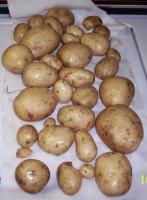
This is Puffergas' first test of growing potatoes in switchgrass compost. The potatoes were grown in containers and charcoal was added to the compost.
See link below:
Potato 2007 by Puffergas

Biochar Trials at Fourth Corner Nursery

Last updated December 06, 2007

Biochar Trials at Fourth Corner Nursery
Richard Haard, Fourth Corner Nursery, Bellingham, WA, December 6, 2007
Hello All - For your interest

I submitted to Tom for posting [attached] some initial soil analysis data from my charcoal block study. In am just beginning to compile a report on this work. When it is posted you will see soil analysis results averaged for each replication(2) for 2 dates , April and October. Listed are pH, Buffer pH, OM, Nitrate, Cation Exchange Capacity (CEC) and base exchange components, % Potassium, % Magnesium, % Calcium. Other soil analysis was taken but not presented here.

Keep in mind this is a 2 to 3 year study and no additional additions or treatments will be done other than continuous cropping and harvest of all growth, tops and roots, at our bare-root native plant nursery. It is my attempt to emulate Christoph Steiner, et al research in Manaus

Long term Effects of manure, charcoal and mineral fertilization on crop production and fertility on a highly weathered Central Amazonian upland soil

http://terrapreta.bioenergylists.org/node/442

Our test was compost, charcoal (two sources) mineral fertilization and control and permutations as was done in experiment above. We're in the moist mild climate of the Pacific NW, USA on a sandy loam soil. It naturally carries very high levels of potassium and calcium found also in unfarmed soil.

I have never tried this kind of intensive soil testing before and am still learning about season to season changes and how to interpet the data. I am working now on photosets taken at harvest time and these will be posted as well as a concise statement on the experiment terms and what I think the results represent.

Rich Haard -
And thanks to Larry Williams for his work with me on this project and his critical comments.

Bokashi Composting Australia

Last updated April 15, 2007

Bokashi Composting Australia
Bokashi Composting Australia, NSW

The Bokashi Bucket

"The Bokashi Bucket is a practical and convenient alternative for transforming kitchen waste into a nutrient rich soil conditioner. This unique composting system uses the revolutionary EM (Effective Micro-Organism) Bokashi to create the ideal conditions for airtight (anaerobic) composting."

How Bokashi Works
Bokashi Workshops
Products
Order Form
News
Contact

"Bokashi kitchen composting is easy and effective!
As Seen on Better Homes & Gardens"

Syndicate content