Biochar
Submitted by Tom Miles on Wed, 2008-02-27 16:16.
Terracarbona.com - A New Website for the Promotion of Biochar Research and Experimentation
Chris Braun. February 27, 2008
A new website for the promotion of biochar research and experiments was born !
http://terracarbona.com
You can there discover several biochar-related projects, most of them still in active development . If you are performing biochar soil amendmend trials yourself, your contribution to CharDB or to the Field Trial Portal would be highly appreciated!
And if you haven't done it so far but would like to start experimenting, you can also find useful resources, links and contacts to help you.
This website is still in its infancy and any constructive comment, critic, question, advice... is very important for further development ! For that you can use the devoted forum:
http://z15.invisionfree.com/CharDB/index.php?showforum=2
Thanks for your contribution!
Sincerely yours,
Chris
terracarbona@bionecho.org
Submitted by Tom Miles on Sat, 2008-02-16 05:45.
Submitted by Tom Miles on Tue, 2008-02-05 05:24.
Effects of mycorrhizal fungi and biochar 75 Days
Robert Flanagan, Hangzhou Sustainable Agricultural Food & Fuel Enterprise Co., Ltd.
(SAFFE), February 5, 2008
I just got to visit my biochar trial at BIOTROP today so I took a few photos to give all you some idea of the profound difference biochar makes to subsoil
Control
Rice Husk Charcoal
Rice Husk Charcoal + VAM
Video:
http://www.youtube.com/watch?v=mvo1w8gFSts
What we're seeing is the plants treated with VAM fungi + biochar are a lot darker green and show more plant growth at the 75day mark so I'll push on up to day90 and see what happens.
Robert Flanagan
Chairman & President
Hangzhou Sustainable Agricultural Food & Fuel Enterprise Co., Ltd.
Skype "saffechina"
Tel: 86-571-881-850-67
Cell: 86-130-189-959-57
Submitted by Tom Miles on Sun, 2008-01-06 04:05.
Charcoal in agriculture: Experimental research at Fourth Corner Nurseries
Richard Haard, Fourth Corner Nurseries, Bellingham, Washington, January 3, 2008
Greetings
I just finished over the last few days organizing images and data from my charcoal experimental plots. I am presenting a new set of posters showing root systems of the native shrub, Lonicera involucrata or black twinberry that I used as an experimental subject in these treatment plots this summer.
This will be the last of a series of piecemeal postings about my findings on the terrapreta reading list. In time, I will prepare a summary of what I have accomplished this year, the shortcomings, what I feel I have learned from this work about using charcoal and my plans for continuing this experiment for 2 or more growing seasons.
Quick background - my employer, Fourth Corner Nurseries is a bare root native plant nursery. We grow more than 350 kinds of plants for environmental restoration and landscaping purposes. Our farm is 60 acres in 2 fields. Shown here is our east field. Formerly, I have been trying charcoal as a soil additive for several years and this season I attempted a controlled experiment. It did not go without a hitch.
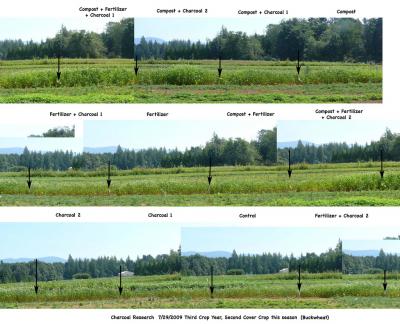
What I established this year was a series of 28 - 17 foot long treatment blocks that are a pair of treatment sets consisting of untreated soil, charcoal only, fertilizer only compost only and combinations of charcoal, compost, fertilizer. In each treatment block 3 kinds of plants were installed: a native shrub, Lonicera; a native perennial - Aster subspicatus; and a vegetable - swiss Chard.
All were selected for their heavy nitrogen consumers and all production was removed from the plots, roots and tops, then the plots replanted and cropped again without further fertilizer, compost or charcoal.
The most detailed measurements accomplished this year is 2 sets of soil chemical analysis completed at a University laboratory. Plant response measurements this year, for several reasons was only visual observation. This set of posters I am presenting today shows subtle but interesting and positive additive effects of compost and charcoal.
Further analysis will be presented at a later date.
How it went. Early April while the plants were still dormant I took 2 year old bareroot Lonicera seedlings trimmed tops and roots and planted in peat/perlite mix in 4X4 inch containers. At these same time I planted
sprigs of Aster in the same manor. After the plants had firmly rooted into the containers and our field soil had warmed, I prepared a growing bed in our normal propagation field ( Field 13, row 8). The growing bed is about 4
feet wide and 500 feet long. I divided this into 17 foot beds with separate treatments in a systematic way. Here is charcoal 1, a fine powder that was donated by JF Waste energy systems. Here is charcoal 2 a lump and powder mix that
Larry Williams and I made with a top draft earth covered mound. I am using the lump charcoal because I can observe microbe utilization over time as Larry has been studying for several years.
Here are the charcoal test beds are they appeared before rototilling. In this image furthest is compost only, then compost/charcoal1,then compost/charcoal2,then compost/charcoal 1/fertilizer and so on in a systematic pattern repeating again in a second duplicate set on the north end of the field. In discussing these tests I sometimes discuss each set separately, are are called south set and north set.
Here are the plots immediately after rototilling. Note that the charcoal does not appear to be uniformly dispersed. After harvest with the
lifter-shaker charcoal is better mixed in the soil. Each bed received about 30 gallons of charcoal. Fertilizer and Composti were applied at rates normal for our farming practices.
We planted the plots in mid May and by late June they looked like this and this and this .
By the end of August the Swiss
Chard had matured and we had our first harvest. Yields were impressive but no trends specific to treatments were noticed.
Here you can see our plot method for measuring yields of swiss chard and also how the separate treatments, Lonicera, Asteri and swiss chard have grown together making assessment of total production rather difficult.
In late October I conducted a survey of the Lonicera component of the research plots. It was the end of the growing season but before the frost defoliated the plants.
Here is how the plots looked. My first look at the data that showed a subtle but encouraging trend of improvement from the use of charcoal 1.
In this set of images notice that the treatments with compost when combined with charcoal tended to be larger.
The same trend is also noticed in the compost/fertilizer/charcoal combinations. By mid November we were ready
to lift all the plant material from the plots, examine the roots and fall replant with a single species crop for next year. Here we have our lifter shaker harvesting the plants, Lonicera with charcoal staining roots and Rena picking up the plants. Later we replanted with our 4
row seeder and reseeding with another native shrub species, Oemleria cerasiformis, chosen because it too is an agressive nitrogen consumer.
Finally the posters I have prepared to compare top growth and root growth in each of the treatment sets. I have organized the images according to groups of treatments as follows: The links are to the larger size images for better viewing. Edit note root images were created 11/15 not 10/25
First Groups 1 and 2 the control sets that received no treatment or had charcoal only
Roots
Field View
Next Groups 3 and 4 fertilizer sets Edit Roots is labeled as Groups 1 and 2
Roots
Field
View
Next Group 5 South end plots compost set
Roots
Field
View
Next Group 6 North end plots compost set
Roots
Field
View
I think these findings will be encouraging information for John Flotvik and many thanks for his donation of charcoal from his pyrolyser and thanks again to Larry Williams , his thoughtful work and helping when it is most needed.
I am looking forward to another season of data from this set of test plots. Comments, ideas, criticism, discussion whatever are appreciated as I am now preparing my season end report.
Richard Haard, Fourth Corner Nurseries, Bellingham,Washington.
Copyright January 3, 2008
Permission for distribution of these materials and images is granted for entire text and images only so long as the author and initial place of publication;"http://terrapreta.bioenergylists.org/" is
cited. Individual images may be used by permission only from author.
Submitted by Tom Miles on Wed, 2008-01-02 05:17.
Agronomic values of greenwaste biochar as a soil amendment
K. Y. Chan, L. Van Zwieten, I. Meszaros, A. Downie,and S. Joseph
Australian Journal of Soil Research 45(8) 629–634, December 2007
Abstract
A pot trial was carried out to investigate the effect of biochar produced from greenwaste by pyrolysis on the yield of radish (Raphanus sativus var. Long Scarlet) and the soil quality of an Alfisol. Three rates of biochar (10, 50 and 100 t/ha) with and without additional nitrogen application (100 kg N/ha) were investigated. The soil used in the pot trial was a hardsetting Alfisol (Chromosol) (0–0.1 m) with a long history of cropping. In the absence of N fertiliser, application of biochar to the soil did not increase radish yield even at the highest rate of 100 t/ha. However, a significant biochar × nitrogen fertiliser interaction was observed, in that higher yield increases were observed with increasing rates of biochar application in the presence of N fertiliser, highlighting the role of biochar in improving N fertiliser use efficiency of the plant. For example, additional increase in DM of radish in the presence of N fertiliser varied from 95% in the nil biochar control to 266% in the 100 t/ha biochar-amended soils. A slight but significant reduction in dry matter production of radish was observed when biochar was applied at 10 t/ha but the cause is unclear and requires further investigation.
Significant changes in soil quality including increases in pH, organic carbon, and exchangeable cations as well as reduction in tensile strength were observed at higher rates of biochar application (>50 t/ha). Particularly interesting are the improvements in soil physical properties of this hardsetting soil in terms of reduction in tensile strength and increases in field capacity.
Keywords: charcoal, char, agrichar, soil strength, soil carbon sequestration, hardsetting soil, slow pyrolysis.
Australian Journal of Soil Research 45(8) 629–634
Submitted: 27 July 2007 Accepted: 2 November 2007 Published: 7 December 2007
Full text DOI: 10.1071/SR07109
See also:Assessing agronomic values of chars to an Australian hardsetting soil presentation to the International Agrichar Initiative conference, Australia, 2007.
Submitted by jeff davis on Sat, 2007-12-29 01:23.
Potato
This is Puffergas' first test of growing potatoes in switchgrass compost. The potatoes were grown in containers and charcoal was added to the compost.
See link below:
Potato 2007 by Puffergas
Submitted by Tom Miles on Thu, 2007-12-13 22:26.
Terra Preta and Ants - Rooftop Experiments
Dr. Sai Bhaskar Reddy, India, December 13, 2007
Dear All,
After the successful field trials in Alkaline soils http://e-alkalinesoilsterrapreta.blogspot.com/ , I have just started second season TP experiments on a small scale on our Roof top in small pots
http://e-terrapretarooftopexp.blogspot.com/. The charcoal is exclusively from use of Magh-1 woodgas or smoke burner stove
http://e-smokeburnerstove.blogspot.com/ designed by me. I would like to share some of my immediate observations.
One day after establishing pots and the seed with soil and charcoal and only soil. I have sowed brinjal seeds in the 6 with charcoal + soil and 6 only soil. To my surprise I saw that in the three control pots the seeds were eaten away by small red ants. The six pots with a mix of about 30% charcoal were untouched by ants. In TP practice the chances of germination of the seed with out any loss to creatures like ants is minimized. I thought this is the first direct benefit of using charcoal. On day two I saw that all the pots without charcoal are with small red ants. There is not a single ant in the pot with charcoal addition.
Although I love ants, to avoid ants eating away the seeds sown, we could always add some charcoal along with the seeds. Second important application is that in the Vermicompost pits some ants eat away the earthworms to avoid such problem and for value addition to the compost to create a habitat for microbes, we could as well add charcoal.
From web I learnt that those you want to avoid toxic chemicals are using charcoal and diatomous earth as a repellant for ants. For photographs please see the blog below.
http://e-terrapretarooftopexp.blogspot.com/
I would like to know from your experiences what could be the other impacts in using Charcoal to the living things existing in soil.
Dr. N. Sai Bhaskar Reddy
The fines of rice hull ash mixed in with stored seeds are very effective in controlling weevils. (Rice hulls have a very high silica content.) The sharp silica structures in the ash scratch the cutinous exoskelton of the first insects to emerge, leaving them to dessicate before they can breed and lay more eggs. (I was taught this in a weekend course by the Tropical Products Insitute, U.K.)
DE (diatomaceous earth) will do the same because of its silica edges, and is also used for pest control in storing grain. It is also recommended to add DE to compost for the same reason: it is not injurious to beneficials in the process like the digestive tract of worms, but will control certain pests that like to colonize compost
piles.
Could it be that the charcoal has similar cystalline structures which keeps the insects away...in fear of being scratched to death...?
Gerald Van Koeverden vnkvrdn at yahoo.ca
According to a old research study, the effect of charcoal fines on insects might have nothing to do with it as an abrasive or 'scratchy'medium. This article shows that certain dusts actually absorb the lipoid layer from the exoskelton of bees without any apparent abrasion, resulting in the dehydration of the insect. The results (Table 1) show that all the dusts effected an increase in the rate of water-loss of the dead bees; that the three most effective dusts were silica gel, Almicide and activated charcoal, the common physical property of these materials being their capacity to act as powerful absorbents; that Bentonite and activated charcoal, both soft materials, were more effective than carborundum, which is hard and highly abrasive. These facts again indicate that abrasion is not an important factor in the action of these dusts in disrupting the waterproofing layers, and suggest furthermore that they may act by adsorbing the lipoid material.
http://jeb.biologists.org/cgi/reprint/32/1/95.pdf
Gerrit
Dear Gerrit
Thanx for this interesting paper.
TECHNICAL NOTICE:
Activated charcoal (from gas mask 300 mesh about 50 micron) is very much different than TP. Activated charcoal is an aggressive - powerful absorbent with specific surface area BET 650-1200 m2/g, while TP is mild with specific surface area BET 25-100 m2/g, As far as I know CALCON Carbon tried to put in activated carbon to soil since long time, but was not successful.
Sincerely yours: Edward Someus (environmental engineer)
Terra Humana Clean Tech Ltd. (ISO 9001/ISO 14001)
3R Environmental Technologies Ltd.
ADDRESS: H-1222 Budapest, Szechenyi 59, Hungary
TEL handy: +(36-20) 201 7557
TEL / FAX: +(36-1) 424 0224
TEL SKYPE phone via computer: Edward Someus
3R TERRACARBON: http://www.terrenum.net
3R CLEANCOAL ENERGY: http://www.nvirocleantech.com
Submitted by Tom Miles on Fri, 2007-12-07 05:03.
Biochar Trials at Fourth Corner Nursery
Richard Haard, Fourth Corner Nursery, Bellingham, WA, December 6, 2007
Hello All - For your interest
I submitted to Tom for posting [attached] some initial soil analysis data from my charcoal block study. In am just beginning to compile a report on this work. When it is posted you will see soil analysis results averaged for each replication(2) for 2 dates , April and October. Listed are pH, Buffer pH, OM, Nitrate, Cation Exchange Capacity (CECi) and base exchange components, % Potassium, % Magnesium, % Calcium. Other soil analysis was taken but not presented here.
Keep in mind this is a 2 to 3 year study and no additional additions or treatments will be done other than continuous cropping and harvest of all growth, tops and roots, at our bare-root native plant nursery. It is my attempt to emulate Christoph Steiner, et al research in Manaus
Long term Effects of manure, charcoal and mineral fertilization on crop production and fertility on a highly weathered Central Amazonian upland soil
http://terrapreta.bioenergylists.org/node/442
Our test was compost, charcoal (two sources) mineral fertilization and control and permutations as was done in experiment above. We're in the moist mild climate of the Pacific NW, USA on a sandy loam soil. It naturally carries very high levels of potassium and calcium found also in unfarmed soil.
I have never tried this kind of intensive soil testing before and am still learning about season to season changes and how to interpet the data. I am working now on photosets taken at harvest time and these will be posted as well as a concise statement on the experiment terms and what I think the results represent.
Rich Haard -
And thanks to Larry Williams for his work with me on this project and his critical comments.
Submitted by Tom Miles on Thu, 2007-12-06 04:51.
Permaculture and Biochar Development - Queensland, Australia
Barry Batchelor, Permaculture Designer, December 6, 2007
Hi All
First I would like to introduce myself, My name is Barry Batchelor and I'm a Permaculture Designer living on a small scale developing sustainable farm 30km North of Brisbane Australia. I'm one of a handful of Permaculturists who are using or testing Biochar in their food systems in Australia.
Permaculture - http://en.wikipedia.org/wiki/Permaculture
While my talent is not the written word, I hope to show off some of the work I have been doing here, this is where my talent is and where my time is spent.
Note: most of the photo's are 200-400k
http://www.biochar.net/image_uploads/biochar/food_forest.jpg
http://www.biochar.net/image_uploads/biochar/polyculture.jpg
This area is the main focus of my permaculture development and is classed as Zone 1 and 2 in permaculture terms. The 2000m2 area is developed as a polyculture food producing environment, it contains many fruit and nut trees, vegi gardens and many different layers of food. This area is 100% organic and will produce most of our food in years to come, it was started 4 years ago from a compacted soil horse paddock. I make about 10000-15000 lt of compost each year in the gardens by hand. I have been adding used coffee waste to this area for years, I add between 50-100lt per week which I get from a local organic coffee shop, while I'm not sure if the charred carbon elements contained in coffee grounds break down or not, it has been an excellent additive to my soils and it's what got me interested in Biochar.
I now produce most of my char onsite here with a 44 gallon drum, using smaller chunks of dried timber, most of the larger logs are added to the food forest as edging or for slowing water run off. I'm always getting my hands on timber from local's around here, I'm also trying to setup a deal with out local country fire crew to let me access timber or char from controlled burn off's.
http://www.biochar.net/image_uploads/biochar/compost.jpg
One of the most impressive things I have seen in my composts is how worms love the added biochar, in a 400lt bin I have noticed up to 80% of the worms are focused in the layers which contain the char, I feel worms play a massive roll in moving char about. As I also char beef bones I'm sure the added calcium attracts them. I have noticed this over the last 4 compost batches I have made.
http://www.biochar.net/image_uploads/biochar/biochar_brew1.jpg
http://www.biochar.net/image_uploads/biochar/biochar_brew2.jpg
I have now started making liquid brew's which to an organic gardener's nose smells great. This batch was brewed for about two weeks with many different inputs including worm farm liquid waste. The char and bio mud was drained out and added to my vegi gardens and the remaining liquid was mixed 50/50 with water and added to my citrus trees, The potash from the char making process, plus fine amounts of char and added fresh humus which slipped past my filter looked like a great root feed for them.
http://www.biochar.net/image_uploads/biochar/vegi_garden2.jpg
http://www.biochar.net/image_uploads/biochar/vegi_garden1.jpg
This is fresh biochar brew and biochar compost which is added on top of my vegi garden soil, the soil is already pretty good with heaps of added humus and a pretty balanced mineral level, I have noticed more worm and bug activity in the soil since adding the char, I have also noticed a better water holding capacity, all soil here is covered with a thick layer of mulch to reduce sun damage and dry out.
http://www.biochar.net/image_uploads/biochar/western_tree_block.jpg
This is a new area of native trees which were planted out with a compost and biochar mix added into the drilled holes, growth has been out standing so far but at this stage I feel that is to do with the tree guard system from http://www.treesforearth.com.au/ I'll let the website explain the use of pink, but I know they have worked well here compared to other areas planted without the use of them. This photo shows about three months growth from small tube stock. I'm sure the 150mm of rain a week after planting had nothing to do with the amount of growth. ;-)
http://www.biochar.net/image_uploads/biochar/biochar_swale.jpg
http://www.biochar.net/image_uploads/biochar/biochar_swale2.jpg
http://www.biochar.net/image_uploads/biochar/biochar_swale3.jpg
This is a two month old 250m long swale which was developed to slow and catch water and create a feed belt for our three horses, I added a 44 gallon drum of Biochar to the downward bank along the entire length and legume live stock fodder trees have been seeded into this, I have been impressed with the growth on the bank of the stabilising grasses which I also seeded. The swale fills and over flows with just 15mm of rain, I noted last week a 36mm heavy rain event increased our dam level by over 35cm because of the swales which makes all the work making them worth while. Please note swales are built on contour and do not flow they are design to fill up and soak into the soil, water that over flows them spills into lower swales or from dam to dam, Permaculture teaches swale design and P.A Yeoman uses these techniques in his Keyline teachings. http://www.keyline.com.au/
For a more in-depth look at my swale and the construction process and costs goto http://www.biochar.net/swale/swale.htm (please note this site/link will break if you use firefox)
Well that's my show and tell for 2007 and as I do enjoy most of the informative posts I'll keep reading and posting when I have something to add from my non science simple farming background :-)
Regards
Barry Batchelor
Permaculture Designer
www.biochar.net
|