Antal

Michael J. Antal, Jr. Renewable Resources Research Laboratory Hawaii Natural Energy Research Institute University of Hawaii at Manoa

Sewage Sludge Charcoal

Last updated November 06, 2008

Sewage Sludge Charcoal
Michael Antal,University of Hawaii, April 2008
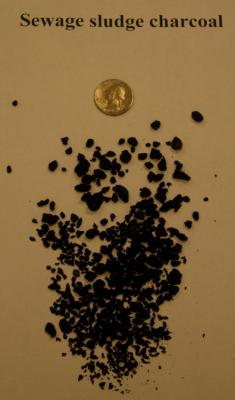
Sewage Sludge Charcoal

I am pleased and somewhat surprised to report that raw sewage sludge is a good feedstock for charcoal production. Details are available on the HNEI website below.

www.hnei.hawaii.edu
Flash Carbonization

Regards, Michael.

Michael J. Antal, Jr.
Coral Industries Distinguished Professor of Renewable Energy Resources
Hawaii Natural Energy Institute
POST 109, 1680 East-West Rd.
Honolulu, HI 96822

phone: 808/956-7267
fax: 808/956-2336
www.hnei.hawaii.edu

Biomass to charcoal in a flash

Last updated August 17, 2007

Biomass to charcoal in a flash
By Dave Koga — The Honolulu Advertiser, July 28, 2007
Michael Antal and Flash CarbonizerMichael Antal and Flash Carbonizer
University of Hawai'i professor Michael Antal Jr. explains flash carbonization, a process that uses heat and pressure to turn green waste into charcoal that can be used as a cleaner-burning alternative to coal.

See also:

Charcoal Properties

Dear friends: terra preta is fascinating in part because it involves so many disciplines. My viewpoint is that of a fuel scientist/chemical engineer.

My laboratory produces well-characterized charcoals for a wide variety of research endeavors, including carbon fuel cell studies, metallurgical charcoal applications, activated carbon production, and terra preta research (with my colleagues Dr. Goro Uehara, Dr. Jonathan Deenik, and Tai McClellan in the University of Hawaii’s College of Tropical Agriculture and Human Resources). With this message I wish to call your attention to the elementary properties of charcoal that I think about when I am producing a charcoal for one of our research endeavors.

Both the feedstock and the process (i.e. pyrolysis) conditions influence the properties of the charcoal product. For example, oak wood has little ash; consequently its charcoal also has little ash. On the other hand, rice hulls have much ash (nearly pure silica), and so does its charcoal.

The Art, Science, and Technology of Charcoal Production

Last updated April 15, 2007

The Art, Science, and Technology of Charcoal Production
Michael Jerry Antal, Jr., Morten Gronli, Ind. Eng. Chem. Res., 42 (8), 1619 -1640, 2003. 10.1021/ie0207919 S0888-5885(02)00791-1 Web Release Date: March 14, 2003

Abstract:

Syndicate content