Volatile Matter (VM)

Growing plants with charcoal

Last updated February 07, 2009

Growing plants with charcoal
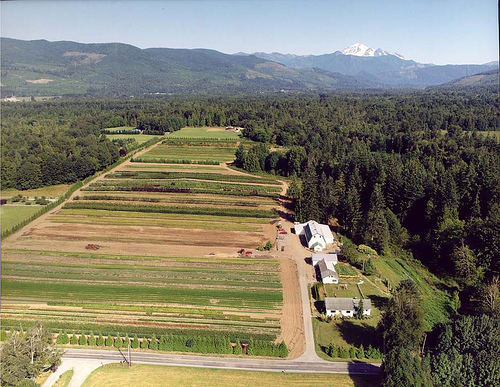
Richard Haard, Fourth Corner Nurseries, Bellingham, WA, June 27, 2007
<

p><img src="http://terrapreta.bioenergylists.org/files/images/396844423_276b3d94eb_0.jpg"" alt="" title="" class="image image-thumbnail " width="200" />

Select image to enlarge
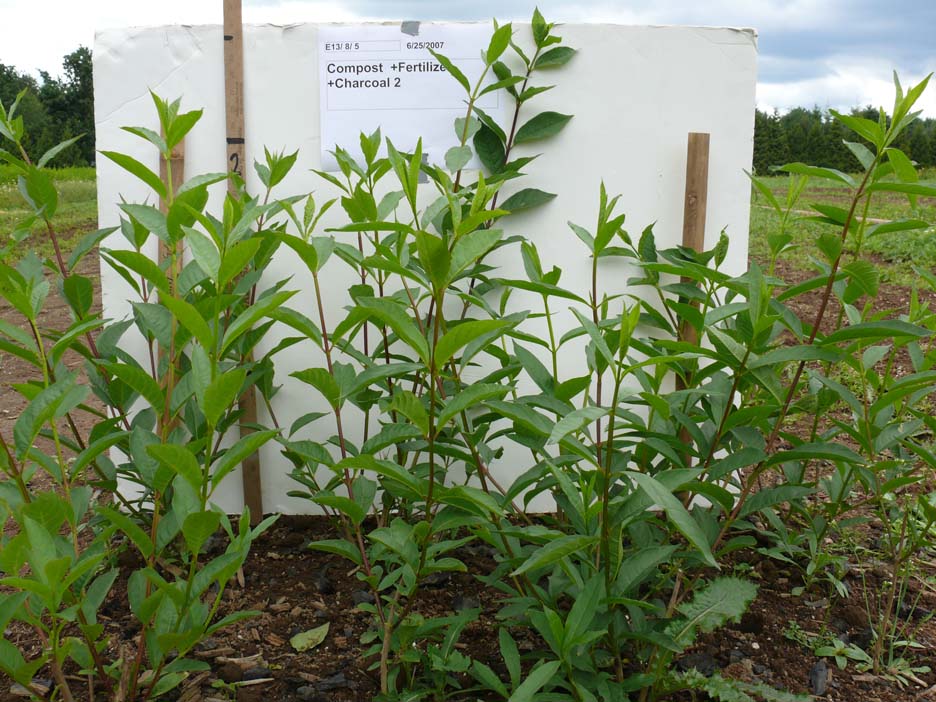
This is an image of our charcoal as soil additive study at our nursery. Shown is one of our test subjects a local native shrub that we propagate and sell for riparian restoration projects. Black Twinberry, Lonicera involucrata. This plant was a 2 year old seedling, bareroot harvested and stems clipped to 6 inches before planting in the test bed 7 weeks ago.

http://farm2.static.flickr.com/1344/634886240_78b8dc7032_o.jpg

and our set of images on the 4CN charcoal project

http://www.flickr.com/photos/rchaard/sets/72157594444994347/
The charcoal in this test plot (charcoal 2) was prepared at our nursery from mostly alder cordwood. We had a proximate analysis on a sample of this charcoal at Hazen Labs. I sent in a sample with the fines and lumps as I applied it. Notice the ash is quite high. A considerable portion of this ' ash ' however is soil that contaminated the charcoal from our top draft earth covered pile

Proximate %
As Recd
Dry
Air dry
MAF
Moisture
34.47
0.00
1.54
0.00
Ash
27.70
42.26
41.61
0.00
Volatile
7.35
11.22
11.05
19.43
Fixed C
30.48
46.52
45.80
80.57
Total
100.00
100.00
100.00
100.00

MAF = Moisture and Ash Free

Lastly we had a surprise visitor to our farm this week and by coincidence when Larry and I were studying our plots. Sean Barry and his family on a vacation trip stopped by and we had a good ole time chatting about charcoal , our project and most everything under the sun

Rich Haard, Propagation Manager, Fourth Corner Nurseries
Bellingham, Washington

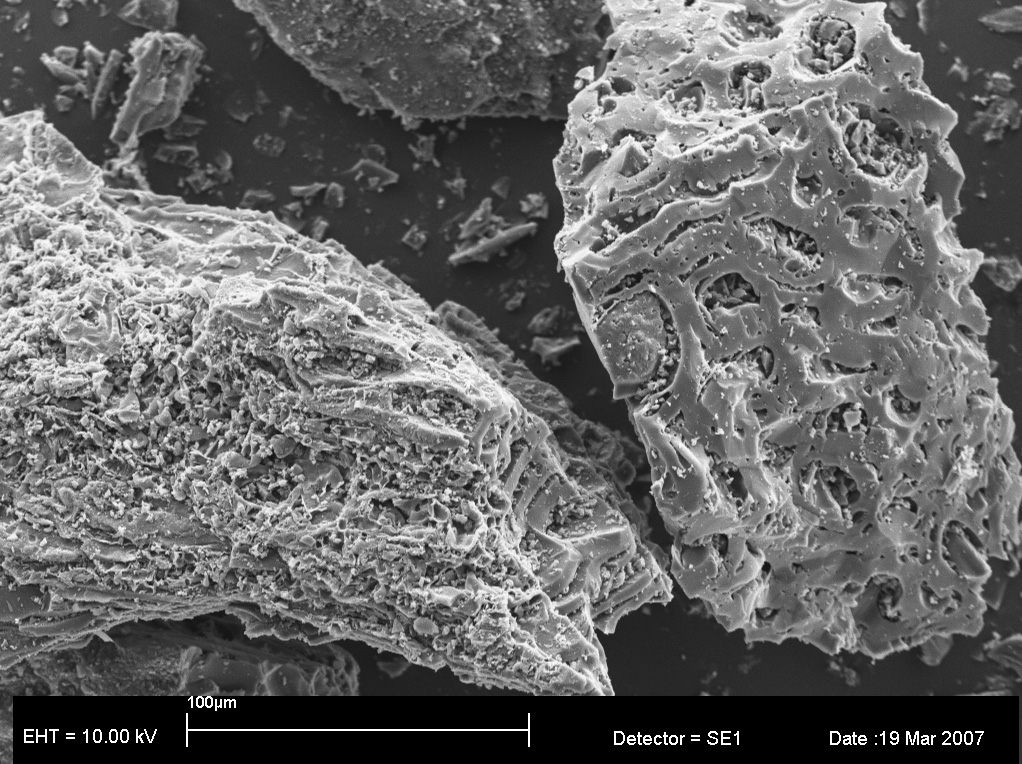
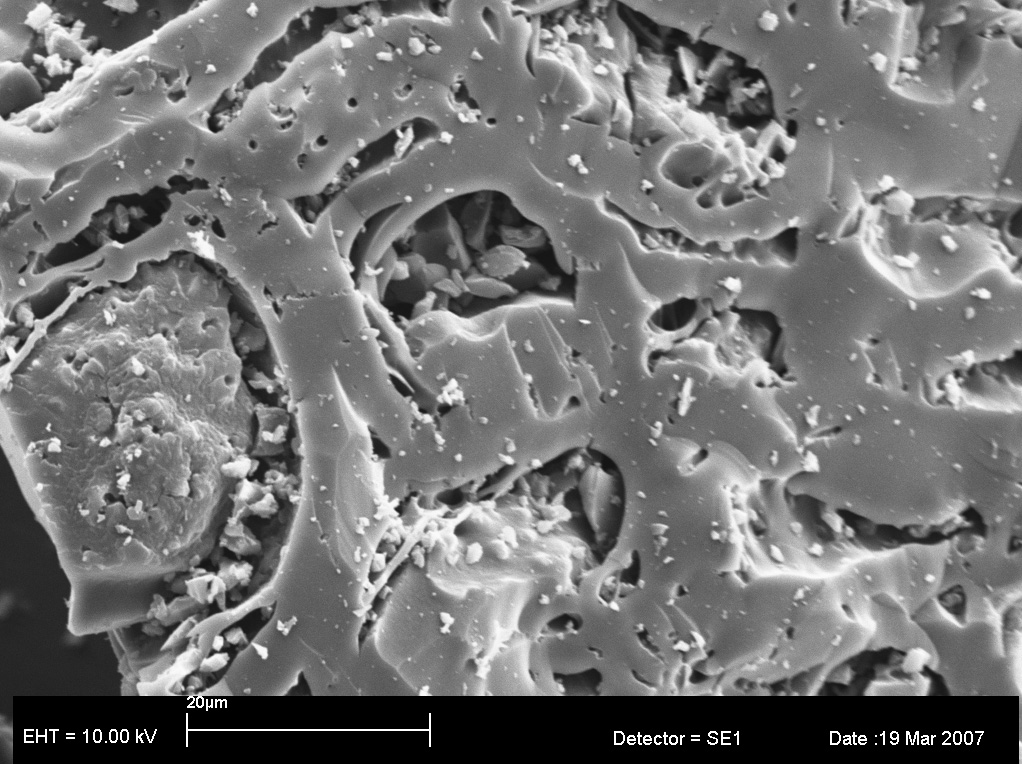
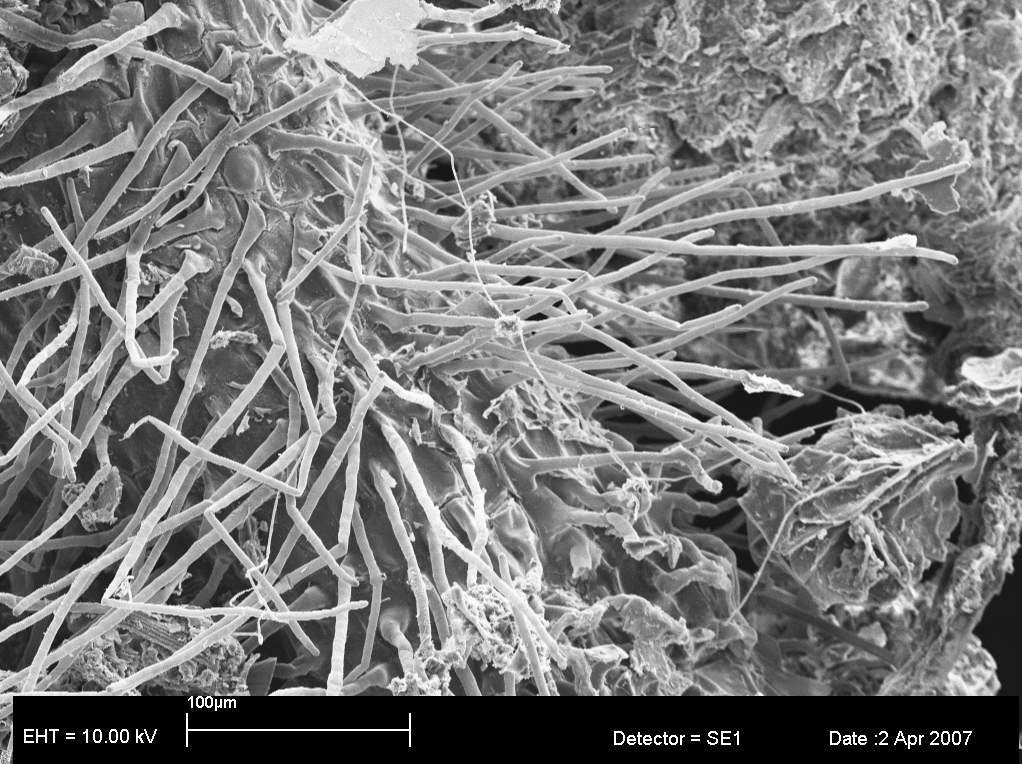
Images of Pyrolysed Biocarbons (PBCs) and Dielectric relaxation of water adsorbed on wood and charcoal

Images of Pyrolysed Biocarbons (PBCs) and Dielectric relaxation of water adsorbed on wood and charcoal
Alfred Harris to Stephen Joseph, BEST Energies, May 8, 2007

SEM Image 21.1b.1 Charcoal to right

Macademia Shells

Factors Influencing Charcoal Quality

Last updated March 08, 2007

What Factors Influence Charcoal Quality?
Tom Miles, Biomass Cooking Stoves June 18, 2006

Temperature

100C -> Wood drying 19 MJ/kg

220C -> Wood becomes brown
250-270C-> Torrefaction 28% fixed carbon, 72% volatile 23.9 MJ/kg
280C -> Wood becomes deep brown-black

300C -> 68% char 32% volatile 40% yield soft, brown, friable

Standard Test Method for Chemical Analysis of Wood Charcoal ASTM D1762-84

Last updated March 05, 2007

Standard Test Method for Chemical Analysis of Wood Charcoal ASTM D1762-84

Attached is the ASTM D1762-84. This test method covers the determination of moisture, volatile matter, and ash in charcoal made from wood. The test method is applicable to lumps and briquets and is designed for the evaluation of charcoal quality. The test method employs apparatus that is found in most laboratories and is adapted to routine analyses of a large number of samples.

Charcoal Properties

Dear friends: terra preta is fascinating in part because it involves so many disciplines. My viewpoint is that of a fuel scientist/chemical engineer.

My laboratory produces well-characterized charcoals for a wide variety of research endeavors, including carbon fuel cell studies, metallurgical charcoal applications, activated carbon production, and terra preta research (with my colleagues Dr. Goro Uehara, Dr. Jonathan Deenik, and Tai McClellan in the University of Hawaii’s College of Tropical Agriculture and Human Resources). With this message I wish to call your attention to the elementary properties of charcoal that I think about when I am producing a charcoal for one of our research endeavors.

Both the feedstock and the process (i.e. pyrolysis) conditions influence the properties of the charcoal product. For example, oak wood has little ash; consequently its charcoal also has little ash. On the other hand, rice hulls have much ash (nearly pure silica), and so does its charcoal.

Syndicate content