Carbonization

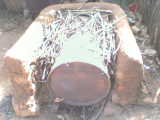
Use the Iwasaki charcoal-making kiln to make charcoal from forest thinnings.

Last updated August 17, 2007

Use the Iwasaki charcoal-making kiln to make charcoal from forest thinnings.
Iwasaki MASATO, Ashikaga Institute of Technology College, Tochigi Prefecture, Japan

The Iwasaki charcoal kiln is made from two steel drum cans.
Since high temperature is used, it takes a very short time to make the charcoal.
Wood (diameter<5cm) charcoal takes less than 5 hours to make.
Bamboo charcoal takes less than 3 hours to make.
This charcoal-making kiln can make be used to make charcoal from corn cobs,

India: Making Charcoal from Prosopis Juliflora

Last updated January 26, 2009

India: Making Charcoal from Prosopis Juliflora
N. Sai Bhaskar Reddy, India April 30, 2007
Prosopis Juliflora Stacked for Charcoal MakingProsopis Juliflora Stacked for Charcoal Making

Chapter 12 - Recovery of by-products from hardwood carbonization

Last updated April 26, 2007

Chapter 12 - Recovery of by-products from hardwood carbonization
in FAO Simple Technologies for Charcoal Making, FAO FORESTRY PAPER 41 FOOD AND AGRICULTURE ORGANIZATION OF THE UNITED NATIONS Rome, 1987

Conversion of Municipal Solid Waste (MSW) into Charcoal & Producer Gas

Last updated April 19, 2007

Conversion of Municipal Solid Waste (MSW) into Charcoal & Producer Gas
Jalaj Kr. Chaturvedi, Shivam Enterprises, Kolkata, April 3, 2007
Charcoal Pellets from MSW

Partially burned material a boon to plants

Last updated April 05, 2007

Partially burned material a boon to plants: Sandy (Oregon) resident sees biochar as a way to fertilize and capture carbon
By Garth Guibord, The Gresham Outlook, Mar 30, 2007

When most people see a pile of sticks and wood, all they see is sticks and wood. Sandy resident Paul Elmore, 39, sees possibilities. He sees biochar – burned organic material that can be used to make plants grow.

Adam + Partner Biocoal: Improved Charcoal Production System (ICPS) and Continuous Carbonization System (CCS)

Last updated April 02, 2007

Adam + Partner Biocoal: Improved Charcoal Production System (ICPS) and Continuous carbonization system (CCS)
Chris Adam, Garmisch, Germany, February 2007

See the new biocoal web site where Chris Adams shows the charcoal production systems and stoves he has developed in Africa and Asia.

See other stories about Chris Adam

Factors Influencing Charcoal Quality

Last updated March 08, 2007

What Factors Influence Charcoal Quality?
Tom Miles, Biomass Cooking Stoves June 18, 2006

Temperature

100C -> Wood drying 19 MJ/kg

220C -> Wood becomes brown
250-270C-> Torrefaction 28% fixed carbon, 72% volatile 23.9 MJ/kg
280C -> Wood becomes deep brown-black

300C -> 68% char 32% volatile 40% yield soft, brown, friable

Indonesia: Charcoal production for Carbon Sequestration

Charcoal production for carbon sequestration (1.1 mb pdf)
Gustan Pari, Djeni Hendra, Dadang Setiawan, Mahpudin Saepuloh, Salim Soleh, Mad Ali (Forest Products Technology Research and Development Center) and Kiyoshi Miyakuni, Nobuo Ishibashi(Japan International Cooperation Agency) April 2004
Demonstration Study on Carbon Fixing Forest Management in Indonesia

Green Charcoal by Pronatura International

Last updated February 08, 2007

Green Charcoal by Pronatura International, France

Two billion people around the world use wood for household energy needs. This contributes significantly to the world's deforestation activities as well as increasing the risk of droughts and desertification. In an attempt to reduce deforestation, Pro-Natura has developed Green-Charcoal.

PRODUCTION OF CHAR FOR AGRICULTURE; A PROFILE OF BEST’S TECHNOLOGY

Last updated February 07, 2007

PRODUCTION OF CHAR FOR AGRICULTURE;A PROFILE OF BEST’S TECHNOLOGY
Biomass energy Services technology, Pty, Saratoga, NSW, Australia February 7, 2007

See attached article.

EXECUTIVE SUMMARY
Recent research work has shown that char in soil can have a range of benefits in the growth of plants. Char can also be used to improve the quality of potting mixes and to remediate soil. In this paper, details of the types of waste that can be converted to char are provided along with the chemical composition of the char. BEST’s Paddle Pyrolysis unit can be used to convert most waste to char, this process is detailed in this document.

Syndicate content