EPRIDA

Agricultural Applications for Biomass Pyrolysis

Last updated February 24, 2009

Agricultural Applications for Biomass Pyrolysis
Jon Nilsson, Carbon Char Group, NJ, Presentation to UN, November 2008

Agricultural ApplicationsAgricultural Applications

Soil Scientist, Jon Nilsson of the Carbon Char Group presented Agricultural Applications for Biomass Pyrolysis at the UN Commission on Sustainable Development Partnerships Fair earlier this year. This was part of the Partnership in New Technologies for Small Island Developing States. The powerpoint of this presentation is available here.

Production and use of a soil amendment made by the combined production of hydrogen, sequestered carbon and utilizing off gases

Last updated August 22, 2008

Production and use of a soil amendment made by the combined production of hydrogen, sequestered carbon and utilizing off gases containing carbon dioxide
United States Patent 20040111968
Day, Danny Marshal (Atlanta, GA, US)
Lee, James Weifu (Knoxville, TN, US)
06/17/2004

FIELD OF THE INVENTION

[0002] This invention relates to the production and use of a nitrogen enriched carbon based fertilizer and soil amendment made during the pyrolytic conversion of carbonaceous materials which produce charcoal and the reaction of said charcoal with ammonia, carbon dioxide, water and other components generally found in flue gas emissions. The invention also relates to the optimization of that charcoal with mineral and plant nutrients to produce and use the combined materials as a soil amendment and fertilizer. The invention also relates to the use of the material as a way to economically store carbon and captured greenhouse gases in the soil.

Examples of Soil Improvement at EPRIDA

Last updated March 10, 2009

Examples of Soil Improvement at EPRIDA
Doug Clayton, April 2007

IMG_7237IMG_7237

Click on photo for full view

I took the pictures when I visited Danny Day at Eprida last month.

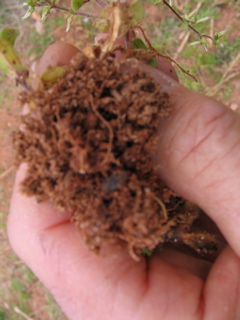
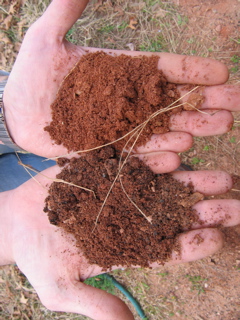
The first shot is of the red Georgia clay before and after charcoal had been tilled in two years prior. The second shows some "structure" as a result of the charcoal treatment. The untreated had become very hard (compacted).

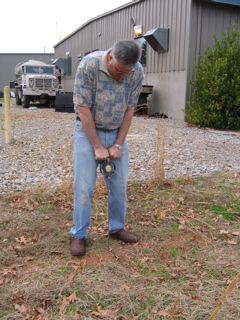
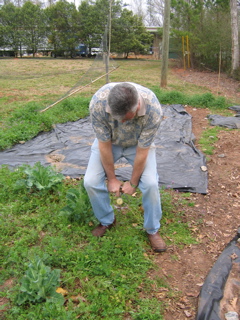
Three and four illustrate how tilth was improved. In both shots Danny
is pushing the device (penetrometer??) with a force of 300#/ sq. in.
and it is obvious how much looser the soil in the fourth image is!

Douglas Clayton
50 Bullard Rd
Jaffrey, NH 03452
work: 603-532-1120
home: 603-532-7321
fax: 603-532-4581

Note: Root penetration decreases linearly with penetration resistance, until almost no roots penetrate into soil with a penetration resistance of 300 psi. See: Measuring Soil Using a Penetrometer Pennsylvania State University

Time to Master the Carbon Cycle

Time to Master the Carbon Cycle
Erich J. Knight, January 16, 2007

Man has been controlling the carbon cycle , and there for the weather, since the invention of agriculture, all be it was as unintentional, as our current airliner contrails are in affecting global dimming. This unintentional warm stability in climate has over 10,000 years, allowed us to develop to the point that now we know what we did and that now we are over doing it.

The prehistoric and historic records gives a logical thrust for soil carbon sequestration.
I wonder what the soil biome carbon concentration was REALLY like before the cutting and burning of the world's virgin forest, my guess is that now we see a severely diminished community, and that only very recent Ag practices like no-till and reforestation have started to help rebuild it. It makes implementing Terra Preta soil technology like an act of penitence, a returning of the misplaced carbon.
The Benefits of Charcoal in the Soil (Research Links)

Last updated June 13, 2007
in

Hydrogen from Biomass Pyrolysis: Integrated Co-Products and Services

Last updated March 10, 2007
in

Hydrogen from Biomass Pyrolysis: Integrated Co-Products and Services
Danny Day, EPRIDA, Biorefining Videoconference, 2004

Distributed Hydrogen Production with Profitable Carbon Sequestration

Last updated March 10, 2007
in

Distributed Hydrogen Production with Profitable Carbon Sequestration: A Novel Integrated Sustainable System for Clean
Fossil Fuel Emissions and a Bridge to the New Hydrogen Economy and Global Socio-Economic Stability
Danny M. Day, Eprida, Inc., 6300 Powers Ferry, Suite 307, Atlanta, Georgia
danny.day@eprida.com, 404-228-8687
Robert J. Evans, National Renewable Energy Laboratory, Golden, Co
James W. Lee, Oak Ridge National Laboratory, Oak Ridge, TN

Introduction and Abstract

Conserve or Invest? What We Earn from Carbon Utilization

Last updated March 05, 2007

Conserve or Invest? What We Earn from Carbon Utilization
Danny Day, Eprida / University of Georgia Bioconversion Center, Presentation to National Association of Conservation Districts, February 9, 2005

Soil erosion, energy scarcity, excess greenhouse gas all answered through regenerative carbon management

Last updated January 21, 2007

Soil erosion, energy scarcity, excess greenhouse gas all answered through regenerative carbon management
Paul Hepperly, The New Farm, Rodale Institute, January 12, 2006

Compost is great, but new bio-based process yields hydrogen and super-stable carbon as charcoal soil booster.

Carbon Cycling: A sustainable path to food and energy

Last updated January 21, 2007

Carbon Cycling: A sustainable path to food and energy (6.6 MB pdf)
Danny Day, Eprida, Alternative Energy Technology Innovations, May 12, 2005

EPRIDA PyrolysisEPRIDA Pyrolysis
Syndicate content