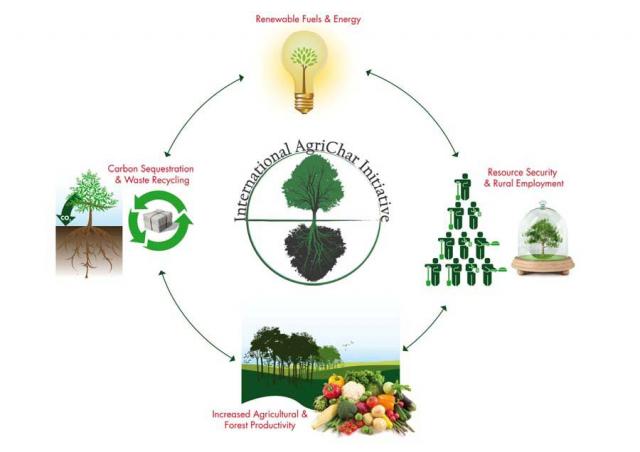
International Agrichar Initiative (IAI)

Agrichar Video

Last updated April 26, 2008

Agrichar Video
Australian Broadcasting Corporation, 2007

Video on Agrichar, International Agrichar Initiative conference (April 2007), BEST Technologies, and use of agrichar in Australia.

http://www.abc.net.au/science/broadband/catalyst/asx/Agrichar_hi.asx

Improving wheat production with deep banded Oil Mallee Charcoal in Western Australia

Last updated April 13, 2008

Improving wheat production with deep banded Oil Mallee Charcoal in Western Australia
Paul Blackwell1, Syd Shea2, Paul Storer3, Zakaria Solaiman4, Mike Kerkmans5, and Ian Stanley6
Agchar Initiative Conference Terrigal New South Wales. April 29 - May 2, 2007

SUMMARY
• There can be benefits to wheat income from deep banded oil mallee charcoal in the low rainfall areas of WA; the trials on acid sandy clay loam and acid sand in 2005 showed up to $96/ha additional gross income at wheat prices of $150/ha; especially when applied with mineral fertilisers and inoculated soil microbes. Much of the yield improvement can be explained by better grain survival, associated with reduced drought stress.

• There were encouraging effects of charcoal on arbuscular mycorrhiza (AM) colonisation. Banded oil mallee charcoal improved AM colonisation of wheat roots by 3 fold, when used with mineral fertilisers and AM is inoculated with the seed in the acid sandy clay loam with a low population of indigenous AM. Early phosphorus uptake was not improved by AM colonisation; P supply from the soil and applied fertiliser was already adequate.

• AM colonisation in spring was related to effects of charcoal application on grain survival in inoculated mineral fertiliser treatments. This infers AM hyphae may have improved water supply to reduce drought stress and loss of grains in these treatments.

• The true economic value of oil mallee charcoal will be clearer when the cost of charcoal production and application is better known and long term effects of charcoal, especially with inoculated AMs and mineral fertilisers is better understood. The potential to achieve a commercial return from the sequestration of charcoal as an offset for carbon
dioxide emissions in broadscale agriculture will also help calculate true economic value.

• More research is worthwhile on the long term effects of incorporated charcoal in a range of soil conditions and seasons, from various sources and how low the banded charcoal rate needs to be to encourage better yields from mineral fertiliser with inoculated AM.

INTRODUCTION
Oil Mallees are the first native woody perennial species to be promoted as a commercial crop in the lower rainfall areas of the southwest land division of Western Australia, primarily stimulated by the need to ameliorate salinity caused by the clearing of native vegetation for agriculture (Bartle and Shea, 2002). Mallees are hardy plants that are well suited as a perennial crop through their ability to re-sprout from the large lignotuber after the above
ground mass has been lost through fire or harvesting. In 2000 a group of Oil Mallee growers from Kalannie (300 km NE of Perth, Western Australia) began producing eucalyptus oil for the Australian market (see the Oil Mallee Association www.oilmallee.com.au ). Integrated processing of mallee biomass to produce electricity, activated carbon and eucalyptus oil in a central processing facility has been the main emphasis of industry development since the late 1990’s. Western Power, Enecon and the Oil Mallee Company have successfully developed a ‘test of concept’ Integrated Wood Processing (IWP) plant at Narrogin. Bell and Bennett (2002) estimated that the NPV of the net benefit to landowners of planting mallees in a local catchment area to supply a 5MW IWP would be about $6.2 million over 20 years. Charcoal is a valuable by-product of such IWPs and a possible by-product of farm based distillation of eucalyptus oil.

It has become well recognised in Japan and some other parts of Asia that charcoal from forestry products and rice hull can stimulate indigenous soil microbial activity (Ogawa, 1994; Nishio, 1996). Charcoal has especially encouraged arbuscular mycorrhiza (AM) which can help supply phosphorus symbiotically to many agricultural crops (Ogawa et al., 1983) and rhizobia, which can fix nitrogen from the atmosphere to supply leguminous plants (Nishio and Okano, 1991). Field experiments in Indonesia (Yamato et al. 2006) showed charcoal made from tree bark applied at 10 L/ha could increase the yield of maize by about 50%, to 15 t/ha, when added to 500 kg/ha of NPK (15:15:15) fertiliser on an acid highly weathered infertile tropical soil; associated with increased AM fungal colonisation. Lehmann and Rondon (2006)
also identify numerous benefits of bio char to plant nutrition and microbial activity in the humid tropics. Benefits of charcoal to soil microbial activity have also been recognised in temperate forest environments (Zakrisson et al. 1996; Pietikainen et al. 2000).

Charcoal seems to assist microbial activity by having a porosity that provides a favourable microhabitat, weak alkalinity and by being a substrate unfavourable for saprophytes (Saito and Marumoto, 2002). AM fungi easily extend their extraradical hyphae into charcoal buried in the soil and sporulate in the particles (Ogawa, 1987). Postma et al. (1990) show evidence that rhizobia in pores <50 _m are protected from predation by protozoan predators; this
could be an important microhabitat property provided by charcoal in soils with low clay content.

Encouragement and establishment of AM fungi in Western Australian soils has encountered many challenges. “The objective of identifying procedure for managing mycorrhizal fungi is more appropriately restated as managing conditions to suit the growth and activity of beneficial populations of mycorrhizal fungi” (Abbot and Gazey, 1994). Introduced AM fungi can suffer competition with indigenous AM fungi and be ineffective for crop phosphorus supply due to high levels of background soluble P (Gazey et al. 2004). Australian native grass species can also be much more efficient at accessing insoluble forms of phosphate than introduced wheat varieties; whose rhizosphere colonies can be very different (Marschner et al. 2006). This may be an adaptation to the low clay content environment of many Australian topsoils; low clay content reduces the amount of small pore space to help some microorganisms prosper. Charcoal in suitable amount and form may provide the missing microhabitat in WA topsoils to help introduced AM fungi and other microbes survive and colonise introduced agricultural crops.

One commercial fertiliser company (Western Mineral Fertilisers; Tenterden WA) has developed products which minimise the abundance of readily soluble phosphorus to encourage symbiotic and other processes of inoculated soil microbes. Zeolite was initially included and intended to provide enhanced ion exchange capacity, and also a micro habitat
within the zeolite pores; however the pore volume may not be sufficient. It was a reasonable hypothesis that charcoal addition may improve the microhabitat further than the use of zeolite.

The opportunity to test hypotheses about charcoal effects on soil and use of soil microbes to improve crop nutrient supply came about in 2005. There was an intensive research effort to examine the efficacy of very wide rows of wheat on shallow soils in the low rainfall areas east of Geraldton (Blackwell et al. 2006; Blackwell 2007). With some support and encouragement from the Oil Mallee Company and Western Mineral fertilisers we developed the following experiments using no-till methods for crop establishment and very wide rows to minimise drought stress. Attempts to follow the long-term effects at Pindar failed due to a very dry winter season in 2006.

See complete paper attached and at:http://www.oilmallee.com.au/pdf/Improving_wheat_prod.pdf
See oral presentation at:
http://www.iaiconference.org/images/Blackwell_-_Improving_Wheat_Production_with_Mallee_Charcoal.pdf

1Department of Agriculture and Food, Geraldton WA, 2 Oil Mallee Company of Australia, 3Western Mineral
Fertilisers, 4University of Western Australia, School of Earth and Geographical Sciences, 5Oil Mallee
Association of WA, 6 "Bungadale", Kalannie , WA

About Biochar: Biochar White Paper

Last updated January 01, 2008

About Biochar: Biochar White Paper
International Biochar Initiative, October2007
Biochar: A Soil Amendment that Combats Global Warming and Improves Agricultural Sustainability and Environmental Impacts
Introduction to Biochar
Biochar and bioenergy co-production from urban, agricultural and forestry biomass can help combat global climate change by displacing fossil fuel use, by sequestering carbon in stable soil carbon pools, and by dramatically reducing emissions of nitrous oxides, a more potent greenhouse gas than carbon dioxide. , As a soil amendment, biochar helps to improve the Earth’s soil resource by increasing crop yields and productivity, by reducing soil acidity, and by reducing the need for some chemical and fertilizer inputs. , Water quality is improved by the use of biochar as a soil amendment, because biochar aids in soil retention of nutrients and agrochemicals for plant and crop utilization, , reducing leaching and run-off to ground and surface waters.
Biochar production and utilization systems differ from most biomass energy systems because the technology is carbon-negative: it removes net carbon dioxide from the atmosphere and stores it in stable soil carbon “sinks”. Other biomass energy systems are at best carbon-neutral, resulting in no net changes to atmospheric carbon dioxide.
Biochar Production
Biochar
Bioenergy
Economics of Biochar Systems
Rural and Developing Country Applications of Biochar Systems

Presentations from the International Agrichar Initiative

Last updated June 10, 2007

Presentations from the International Agrichar Initiative
International Agrichar Initiative 2007 Conference, Terrigal, Australia, April 29 - May 2, 2007

Monday, April 30, 2007: Conference Day 1

8:00 am – 8:30 am: Henry Kendall Ballroom
Welcome to Country, Welcome to Conference, Meeting Overview
Stephen Joseph, BEST Energies, AUS
Debbie Reed, International Agrichar Initiative, USA

Poster Presentations from IAI Conference Now Available Online

Last updated June 10, 2007

Poster Presentations from IAI Conference Now Available Online
International Agrichar Initiative 2007 Conference April 29 - May 2, 2007

Posters:

AGRICHAR AS A MATERIAL
*Joseph, S., A. Downie, J. Lehmann: Classification of Chars for Agricultural Use
*Novotny, E.H. et al.: NMR Characterization of Biofine’s By-products Char

Mallee Charcoal: part of a beneficial cycle?

Last updated February 07, 2009

Mallee Charcoal: part of a beneficial cycle?
Western Mineral Fertilisers, Australia April 2007

Mallee charcoal

Mallee Charcoal

See presentation: Blackwell P, Shea S, Storer P, Kerkmans M, Stanley I: Improving wheat production with deep banded Oil Mallee charcoal in WA

Special Report: Inspired by Ancient Amazonians, a Plan to Convert Trash into Environmental Treasure

Last updated May 16, 2007

Special Report: Inspired by Ancient Amazonians, a Plan to Convert Trash into Environmental Treasure
Anne Casselman, Scientific American.com, In Focus May 15, 2007

New bill in U.S. Senate will advocate adoption of "agrichar" method that could lessen our dependence on fossil fuel and help avert global warming

Conference Announcement for the International Agrichar Initiative (IAI)

Last updated April 21, 2007

Conference Announcement for the International Agrichar Initiative (IAI) April 29-May 2, 2007 Terrigal, New South Wales, Australia

Australia leads the way in a new approach to removing carbon dioxide from the atmosphere

Last updated April 21, 2007

Australia leads the way in a new approach to removing carbon dioxide from the atmosphere
Stephen Joseph, Best Energies, Australia, February 7, 2007

Australia has been selected as the host of the first International Conference on the use of Agrichar (also known as Bio-char), to be held between 29th April and 2nd May, 2007 in the sea-side resort of Terrigal, just a few hours drive from Sydney.

Syndicate content