Temperate

Effects of Charcoal on Manure in a Temperate Forest Ecosystem: A Greenhouse Study

Effects of Charcoal on Manure in a Temperate Forest Ecosystem: A Greenhouse Study
Clarice Pina, Project Train 2005, University of Montana, 2005 with Tom Deluca.

http://www.umt.edu/projecttrain/posters/2005%20Posters/Clarice%20Pina.ppt

Abstract
A greenhouse study was conducted for and eight week period studying the effects of charcoal on manure within a temperate forest ecosystem. Charcoal posses properties that lead us to devise the creation of a unique synergy between manure and charcoal, a land use treatment used in ancient Amazonia. A negative effect was observed with respect to overall biomass per treatment caused by manure application but this effect was eliminated with the addition of charcoal. Manure significantly increased the amount of available phosphorus. Fresh manure may have cause a microbial inhibition to occur yielding unexpected results with ammonium and nitrate concentrations. Altering the rates of both manure and charcoal may help us to locate the source of these unexpected results.

Results:
Salient findings:
Additions of charcoal and manure individually did not have a significant effect on the amount of available NH4+, but the Manuchar treatments were found to have a moderately significant effect on available NH4+ (refer to Figure 1).
All treatments (charcoal only, manure only, as well as manuchar) have a highly significant effect on the amount of available NO3- (refer to Figure 2).
Manure significantly decreased the total amount of NO3-.
With regard to the amount of available P, the manure only treatment had the greatest concentration measured as mg kg-1 PO4-.
Manure applications had a very highly significantly effect, increasing the amount of available-P by almost a factor of 2(refer to Figure 3).
Manuchar treatments were also found to have a highly significant effect on the amount of available-P.
Significant differences were found between treatments with regard to biomass obtained, and manure applications were found to have a negative effect on biomass (refer to Figure 4).


Learning to use wood charcoal in farming

Learning to use wood charcoal in farming at a Northwestern Washington native plant nursery.
Richard Haard, Fourth Corner Nurseries, Washington, Febuary 20, 2007
My motivation for preparing this post is to be able to use this motivate discussion of charcoal as a soil additive. Trying to do this work at a very busy nursery that is perhaps pushing their production factor too high (over 80%) is rather frustrating as experiments have gotten over ruled by planning changes, wiped out by harvest before I can read the data and the conditions set up for the experiment just do not work. However, I have been encouraged however and I am now using hardwood charcoal as a carrier for natural inocculum as a matter of routine.
Fourth Corner Nurseries is a wholesale supplier of native plant species, located on 77 acres in the coastal lowlands of northwestern Washington, USA. With approximately 40 acres under cultivation, we produce two/three million direct-seeded, field-grown, bare-root native plants annually. Our principal crop is individually seed-sourced, bare-root deciduous trees and shrubs, herbaceous perennials, grasses and emergent species such as sedges, cattails and rushes for environmental restoration purposes. Our mission is to sustainably grow plants while supporting workers and their families who depend on the farm for their economic subsistence. Use of surplus biomass from our willow coppice field and other materials is our alternative energy vision.
Aerial view of our farm

Aerial View of Fourth Corner Nurseries

Aerial View of Fourth Corner Nurseries

Richard Haard: Affinity of fungi and crop plant roots to charcoal

Richard Haard: Affinity of fungi and crop plant roots to charcoal
Richard Haard, February 12, 2007

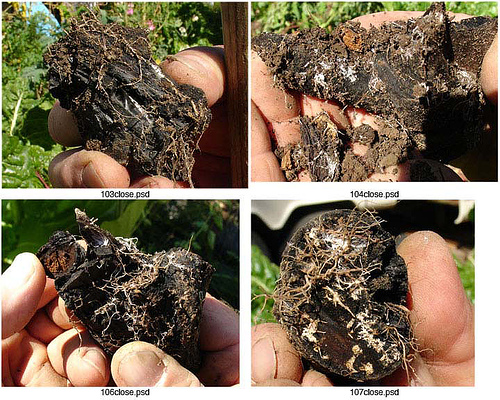
The image below illustrates the affinity of fungi and crop plant roots to charcoal.

Charcoal placed in a fertile garden for a few months showing how crop roots (Swiss chard) and fungi are attached to this medium as habitatCharcoal placed in a fertile garden for a few months showing how crop roots (Swiss chard) and fungi are attached to this medium as habitat

Syndicate content