Shrubs

Growing plants with charcoal

Last updated February 07, 2009

Growing plants with charcoal
Richard Haard, Fourth Corner Nurseries, Bellingham, WA, June 27, 2007

<

p><img src="http://terrapreta.bioenergylists.org/files/images/396844423_276b3d94eb_0.jpg"" alt="" title="" class="image image-thumbnail " width="200" />

Select image to enlarge
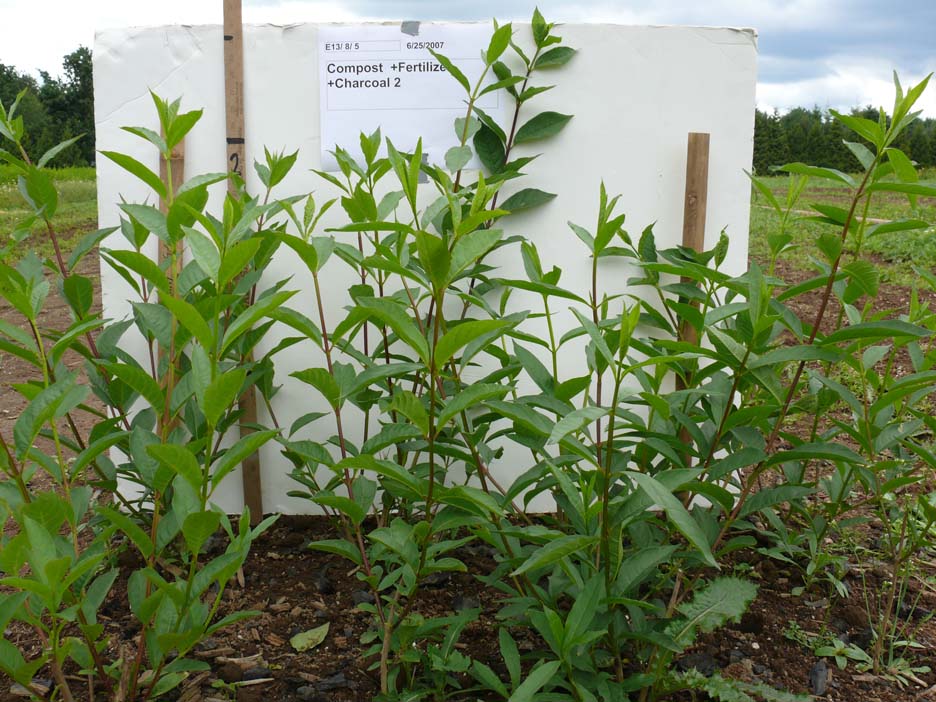
This is an image of our charcoal as soil additive study at our nursery. Shown is one of our test subjects a local native shrub that we propagate and sell for riparian restoration projects. Black Twinberry, Lonicera involucrata. This plant was a 2 year old seedling, bareroot harvested and stems clipped to 6 inches before planting in the test bed 7 weeks ago.

http://farm2.static.flickr.com/1344/634886240_78b8dc7032_o.jpg

and our set of images on the 4CN charcoal project

http://www.flickr.com/photos/rchaard/sets/72157594444994347/

The charcoal in this test plot (charcoal 2) was prepared at our nursery from mostly alder cordwood. We had a proximate analysis on a sample of this charcoal at Hazen Labs. I sent in a sample with the fines and lumps as I applied it. Notice the ash is quite high. A considerable portion of this ' ash ' however is soil that contaminated the charcoal from our top draft earth covered pile

Proximate %
As Recd
Dry
Air dry
MAF
Moisture
34.47
0.00
1.54
0.00
Ash
27.70
42.26
41.61
0.00
Volatile
7.35
11.22
11.05
19.43
Fixed C
30.48
46.52
45.80
80.57
Total
100.00
100.00
100.00
100.00

MAF = Moisture and Ash Free

Lastly we had a surprise visitor to our farm this week and by coincidence when Larry and I were studying our plots. Sean Barry and his family on a vacation trip stopped by and we had a good ole time chatting about charcoal , our project and most everything under the sun

Rich Haard, Propagation Manager, Fourth Corner Nurseries
Bellingham, Washington

Azotobacter Question and Answer June 2007

Last updated June 12, 2007

Azotobacter Question and Answer June 2007
Richard Haard, Four Courner Nursery, Bellingham, Washington, June 11, 2007

Question by Sean Barry:
RH ". . .Learning about potential for enrichment culture of Azotobacter and trying to measure available nitrogen in this situation."

Here you mention promoting the growth of nitrogen fixing Azotobacter. I have always been interested in the possibility of inoculating charcoal with mycorrhizal fungi.

Learning to use wood charcoal in farming

Learning to use wood charcoal in farming at a Northwestern Washington native plant nursery.
Richard Haard, Fourth Corner Nurseries, Washington, Febuary 20, 2007
My motivation for preparing this post is to be able to use this motivate discussion of charcoal as a soil additive. Trying to do this work at a very busy nursery that is perhaps pushing their production factor too high (over 80%) is rather frustrating as experiments have gotten over ruled by planning changes, wiped out by harvest before I can read the data and the conditions set up for the experiment just do not work. However, I have been encouraged however and I am now using hardwood charcoal as a carrier for natural inocculum as a matter of routine.
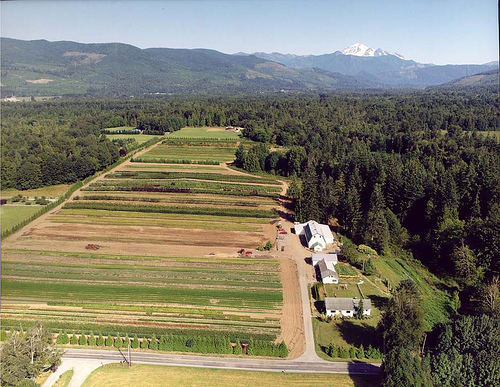
Fourth Corner Nurseries is a wholesale supplier of native plant species, located on 77 acres in the coastal lowlands of northwestern Washington, USA. With approximately 40 acres under cultivation, we produce two/three million direct-seeded, field-grown, bare-root native plants annually. Our principal crop is individually seed-sourced, bare-root deciduous trees and shrubs, herbaceous perennials, grasses and emergent species such as sedges, cattails and rushes for environmental restoration purposes. Our mission is to sustainably grow plants while supporting workers and their families who depend on the farm for their economic subsistence. Use of surplus biomass from our willow coppice field and other materials is our alternative energy vision.
Aerial view of our farm

Aerial View of Fourth Corner Nurseries

Aerial View of Fourth Corner Nurseries
Syndicate content