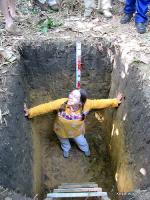
Amazon dark earth
Submitted by Visitor on Tue, 2007-01-23 08:49.
Springer-Verlag and Kluwer Academic Publishers have obviously done well with the first two books. Now they want a third. At $400+ a pop I would want a new volume too !
michael
Call for Contributions
“Terra Preta Nova: A Tribute to Wim Sombroek”
Edited by William I. Woods1, Wenceslau Teixeira2, Johannes Lehmann3, Christoph Steiner4, and Antoinette WinklerPrins5
1University of Kansas, USA (wwoods@ku.edu); 2 Embrapa Amazônia Ocidentali, Brazil (wgt007@hotmail.com); 3Cornell University, USA (cl273@cornell.edu); 4University of Bayreuth, Germany (christoph.steiner@uni-bayreuth.de); 5Michigan State University, USA (antoinet@msu.edu)
Submitted by Tom Miles on Mon, 2007-03-05 03:24.
Bio-char (Black Carbon) Stability and Stabilization in Soil
Johannes Lehmann, Cornell Univ, Ithaca, NY 14850 and Saran Sohi, Rothamsted Researchi, Harpenden, AL5 2JQ, United Kingdom
18th World Congress of Soil Science, July 9-15, 2006 - Philadelphia, Pennsylvania, USA
Submitted by Tom Miles on Sun, 2007-01-21 19:30.
Terra Preta de Indio
Johannes Lehmann. Soil Biogeochemistry, Cornell University January 2007
"Terra Preta de Indio" (Amazonian Dark Earths; earlier also called "Terra Preta do Indio" or Indian Black Earth) is the local name for certain dark earths in the Brazilian Amazon region. These dark earths occur, however, in several countries in South America and probably beyond. They were most likely created by pre-Columbian Indians from 500 to 2500 years B.P. and abandoned after the invasion of Europeans (Smith, 1980; Woods et al., 2000). However, many questions are still unanswered with respect to their origin, distribution, and properties.
Submitted by Tom Miles on Sun, 2007-01-21 07:00.
AGROBIODIVERSITY IN AMAZÔNIA AND ITS RELATIONSHIP WITH DARK EARTHS
CHARLES R. CLEMENT 1, JOSEPH M. MCCANN 2, NIGEL J. H. SMITH 3
1Instituto Nacional de Pesquisas da Amazônia, INPA, Manaus, AM, Brasil,
2Division of Social Sciences, New School University, New York, NY 10011 USA, 3Department of Geography, University of Florida, Gainesville, FL, USA
in
Chapter 9 In: Lehmann, J.; Kern, D.; Glaser, B.; Woods, W. (Eds.). Amazonian Dark Earths – Origin, Properties, and Management. Kluwer Academic Publ., Dordrecht. pp. 159-178.
Submitted by Tom Miles on Sun, 2007-01-21 05:41.
I INTERNATIONAL WORKSHOP ON ANTHROPOGENIC TERRAi PRETA SOILS [NOVOTEL], MANAUS, BRAZIL, 13-19 JULY 2002.
Organized by INPA, EMBRAPA, UA, MPEG, USP
Program
Publications
Submitted by Tom Miles on Sun, 2007-01-21 04:48.
Submitted by Tom Miles on Sun, 2007-01-21 04:30.
DISCOVERY AND AWARENESS OF ANTHROPOGENIC AMAZONIAN DARK EARTHS (TERRA PRETA)
William M. Denevan, University of Wisconsin-Madison
William I. Woods, Southern Illinois University, Edwardsville
“Somewhere, Something Incredible Is Waiting To Be Known”
Words of a brilliant and wise man, Carl Sagan. And indeed, some of the things
we will be talking about over the next two days are incredible and have only recently
become known. Amazonian dark earth is incredible for its own sake, but even more so
because of its implications for sustained cultivation, energy generation, global
Submitted by Tom Miles on Sun, 2007-01-21 04:15.
Amazonian Dark Earths: Origin, Properties, Management
Johannes Lehmann, Dirse C. Kern, Bruno Glaser, William I. Woods
This book publication emerged from a meeting in Benicassim, Spain, in 2001. A group of enthusiastic scientists from diverse backgrounds decided that it is time to present a comprehensive overview over research on the so-called "Terra Preta de Indio", or Amazonian Dark Earths. Authors were invited to cover a wide variety of aspects around these fascinating soils, and met what became the first International Workshop on Terra Preta de Indio, in Manaus in July 2002. The frequent interactions and the workshop meeting ensured that this publication became a major text book on Amazonian Dark Earths. It is published by Kluwer Academic Publishers in The Netherlands
|