Maize

Trials in Maize, reactivating dormant genes using high doses of Salicylic acid and Charcoal

Last updated October 29, 2009

Nikolaus Foidl, October, 2009
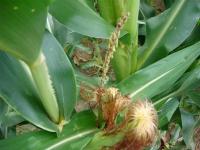
Recent literature suggest that the split from a common ancestor between rice and the ancestor of maize happened some 45 to 60 million years ago. Maize was formed from teosinte as a common ancestor. Sorghum apparently split from the common ancestor with maize sometimes between 16.6 and 11.9 million years ago.

If the environment is overcharging the abilities of the gene set, then the plant seems simply to split up in different lines of development (??), although keeping the, during evolution silenced gene sets, or inactivated subprograms.
Now and then, trigger events, like stress or chemical influence, or not compatible gene sets in hybridizations, cause those silenced subprograms to activate and express themselves causing to see, what’s hiding in their past.

These so called trash genes, with apparently no function, have still a function and can be switched on or off as genetic expression If we find out the trigger mechanism, and as well if we find out their ancient function and the use of their reactivation in an actual environment, we might be able to get much higher productivities per ha, then by raising densities.

In the example of Maize, I want to show, when using Salicylic acid in high doses together with bio char, we have the possibility to get a glimpse of what reactivation could bring us as a useful gene expression in future.

Syndicate content